How do marine engineers select the right material for lightweight deck panels? The ideal choice balances high stiffness-to-weight ratio, low moisture absorption, and manufacturing process compatibility to reduce weight above the waterline while maintaining structural integrity.
What Makes a Marine Deck Panel Lightweight?
A deck panel is not simply lightweight because it feels easy to lift. It must support high operational loads across frames and stringers without excessive deflection. It needs to withstand dynamic wave slams, point loads from crew and equipment, and continuous cyclic stress. Achieving this performance requires efficient sandwich construction rather than a thick, solid sheet of material.
Lightweight sandwich structures separate structural depth from total mass. High-strength skins are placed at the outer faces where bending stresses peak, while a low-density core material supports the cross-section against shear forces. This design provides high stiffness-to-weight performance, allowing composite panels to match the rigidity of traditional marine plywood while reducing total component mass by 30% to 70%.
Core materials, skin materials, and panel construction
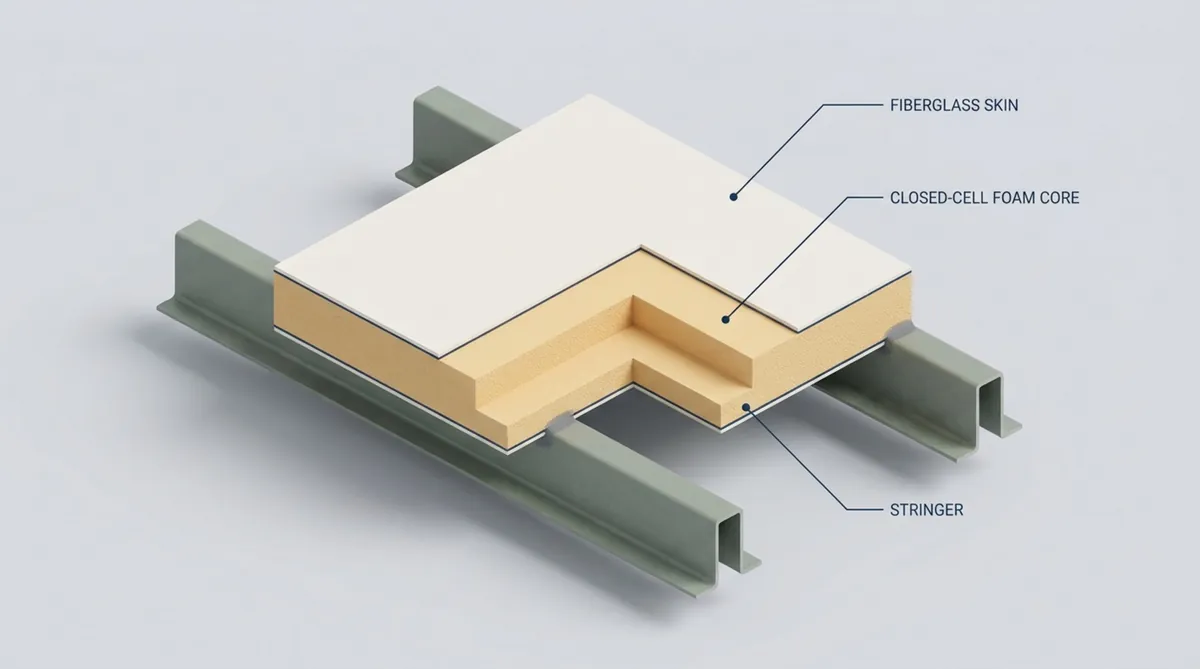
Modern lightweight decks rely on sandwich construction. A sandwich panel pairs two thin, high-tensile skin laminates with a thicker, low-density structural foam core. The skins carry in-plane tension and compression during bending. The core maintains skin spacing, prevents local skin buckling, and transfers shear loads. Common core materials include structural foam cores such as polymethacrylimide (PMI foam), cross-linked PVC, and PET, alongside honeycomb structures and end-grain balsa.
Skin selection also dictates structural performance. Common options include woven E-glass fiber impregnated with vinyl ester or epoxy resin, high-modulus carbon fiber, and marine-grade sheet aluminum. Manufacturers assemble these sandwich structures using vacuum infusion, resin transfer molding (RTM), or prepreg autoclave processing. A strong bond between the core and skins is critical; if the bond fails, the structure loses its stiffness. When properly consolidated, the composite assembly functions as an efficient, lightweight I-beam across the deck framing.
How panel weight affects vessel capacity, stability, and fuel use
Deck mass plays a critical role in naval architecture because the deck structure sits well above the center of buoyancy. Removing weight high in the vessel lowers its vertical center of gravity (VCG). This shift improves transverse stability, reduces vessel roll, and enhances crew comfort in open seas. On high-speed planing hulls, reducing top weight also permits narrower, more efficient hull geometries.
Minimizing deck structure mass directly expands useful payload capacity. The vessel can accommodate additional fuel, fresh water, gear, or passenger load without exceeding displacement limits. Lower displacement reduces wetted surface area and hydrodynamic drag, which decreases the power needed to reach planing speeds and lowers fuel consumption over extended transits.
Which Performance Factors Should Guide Material Choice?
Selecting deck panel materials requires a clear evaluation of operating loads and marine exposure. Deck panels are active structural components that experience cyclic wave action, point loading from hardware, solar radiation, and continuous contact with saltwater. Material selection must satisfy all mechanical, environmental, and thermal engineering requirements simultaneously.
Engineers assess a wide range of mechanical properties prior to fabrication. Overlooking thermal stability, impact resistance, or core moisture intake can lead to premature skin delamination and structural failure under marine operating conditions.
Strength-to-weight ratio and load capacity
The strength-to-weight ratio remains the primary benchmark in lightweight engineering, but it encompasses several distinct loading modes. Flexural stiffness determines resistance to panel sagging between deck beams. Compressive strength dictates resistance to concentrated point loads, such as those imposed by deck machinery, seating pedestals, and mooring cleats. While very low-density honeycomb panels span wide gaps with minimal static deflection, their thin skins can crush under localized loads if they lack internal reinforcement.
Designers must apply safety factors to account for sudden dynamic forces. Moving crew, falling gear, and hydraulic slamming from breaking waves produce loads several times higher than static deck weights. The composite panel must flex elastically under these impacts and recover without microcracking the resin matrix or causing permanent core deformation.
Water absorption, rot resistance, and dimensional stability
Water infiltration poses a continuous threat to marine decks. If a core absorbs moisture through unsealed fastener penetrations, the vessel re-accumulates the parasitic weight that the design aimed to eliminate. Moisture can also trigger core rot, fungal growth, or freeze-thaw damage. Closed-cell structural foam cores resist water uptake, preserving panel mass and structural integrity if outer seals degrade.
Dimensional stability under varying thermal conditions is equally critical. Marine decks absorb solar heat on exposed surfaces while the underside is cooled by seawater and cabin air conditioning. Materials with high thermal expansion rates can warp, generate internal shear stress at adhesive bond lines, and tear perimeter sealants. High-performance structural cores maintain dimensional stability to keep deck seams sealed and flat over decades of exposure.
UV, saltwater, chemicals, and impact resistance
Exposed decks endure harsh environmental conditions. Ultraviolet radiation degrades unprotected resins, causing surface chalking, brittleness, and microcracking. UV-stabilized gelcoats, polyurethane topcoats, and protective skin barriers mitigate this degradation. Saltwater exposure accelerates corrosion at joints, while diesel exhaust, hydraulic fluids, cleaning detergents, and chemical washdowns test the chemical resistance of the surface matrix.
Toughness and impact resistance are essential for routine deck operations. Decks must withstand dropped metal shackles, dive gear, anchor chains, and rough footwear without fracturing the skins. Incorporating tough resin systems and high-shear structural foam cores helps dissipate impact energy without causing internal core crushing or delamination.
Which Materials Are Used for Lightweight Marine Deck Panels?
Naval architects and shipyards choose from both traditional building materials and modern synthetic systems. Each option presents distinct trade-offs regarding material cost, weight, structural stiffness, and fabrication complexity.
Evaluating the mechanical limits of each material system ensures the selected deck panel aligns with production capabilities, budget constraints, and operational requirements.
Marine-grade plywood
Marine-grade plywood remains a baseline reference for marine decking. Standard panels use hardwood veneers, such as Okoume or Meranti, bonded with moisture-resistant phenolic adhesives. High-grade marine plywood contains no internal veneer voids where moisture can accumulate. Okoume offers a relatively low density among structural woods, making it a common choice for wood-epoxy marine construction.
However, wood remains susceptible to moisture absorption. Marine plywood requires complete encapsulation with epoxy resin and fiberglass fabrics to maintain moisture exclusion. If mechanical fasteners breach this barrier without adequate potting, water penetrates the inner plies, initiating rot, adding hidden water weight, and compromising structural safety.
Aluminum panels
Marine-grade aluminum deck panels commonly utilize 5052 or 6061-T6 alloys. Aluminum provides consistent isotropic strength, does not rot, and is completely non-combustible. Deck configurations often feature extruded planking with integral stiffeners or bonded aluminum honeycomb sandwich assemblies, offering high stiffness-to-weight ratios.
Aluminum does present specific operational challenges. It exhibits high thermal conductivity, becoming very hot under direct sunlight and cold in winter conditions. Without dampening treatments, aluminum decks transmit structural vibration and engine noise. Furthermore, builders must electrically isolate stainless steel fasteners using non-conductive sleeves and isolation pastes to prevent rapid galvanic corrosion in marine environments.
HDPE and recycled plastic panels
High-Density Polyethylene (HDPE) and expanded polymer boards are frequently specified for non-structural and semi-structural deck areas. These polymer sheets do not rot, resist harsh marine washdown chemicals, and do not require protective paint or gelcoat. Non-skid patterns can be milled or molded directly into the walking surface.
The primary engineering limitation of HDPE is its low flexural modulus and tendency to creep under sustained loads or elevated ambient temperatures. Solid HDPE panels require closely spaced frame supports to prevent visible sagging over time. Consequently, HDPE is typically limited to hatch lids, swim platform grating, and utility boat walkways rather than structural deck expanses where minimal weight is the primary goal.
Composite and fiberglass panels
Composite sandwich panels using fiber-reinforced polymer (FRP) skins over closed-cell structural foam cores deliver among the highest stiffness-to-weight ratios available. High-performance structural foam cores, such as closed-cell polymethacrylimide (PMI) like Rohacell IG-F or high-density PVC, maintain rigidity without adding excessive mass. These cores do not rot and have closed cells that prevent moisture migration.
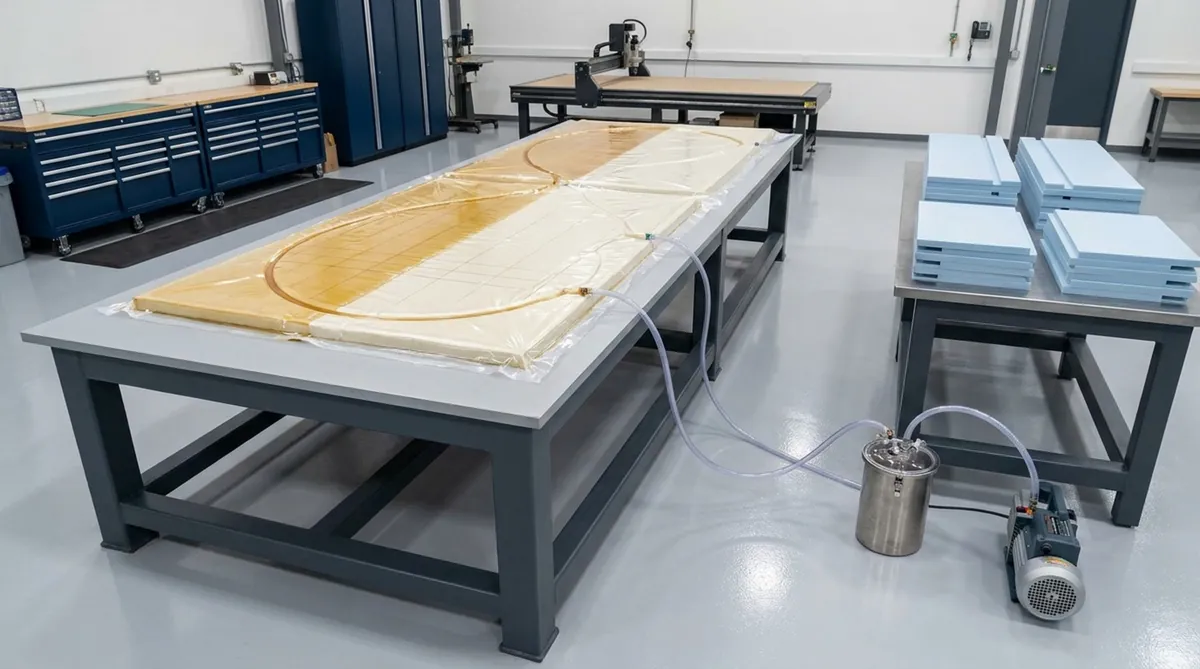
Composite panels exhibit outstanding corrosion resistance in saltwater. While their upfront material cost is higher than timber, they support advanced composite manufacturing methods such as vacuum infusion and single-step co-curing. The resulting components deliver exceptional service life, low maintenance requirements, and reliable structural performance in demanding offshore environments.
How Panel Design Improves Lightweight Deck Performance
Material properties alone do not guarantee performance. The structural geometry and assembly design dictate how the finished panel behaves under real-world loads. Optimizing the core thickness, skin layup, and boundary terminations maximizes strength while eliminating parasitic mass.
By engineering internal core densities and moisture barriers, composite fabricators construct panels that outperform solid plates in stiffness, thermal insulation, and service life.
Foam-core sandwich panels and cored composites
A foam-core composite functions like an engineering I-beam. When a downward bending load is applied to the deck, the upper skin experiences compression while the lower skin experiences tension. The structural foam core maintains the separation between skins and carries the resulting shear stresses. Increasing core thickness significantly elevates panel stiffness with only a negligible increase in total component weight.
Structural foam cores also deliver acoustic and thermal insulation. A composite deck dampens engine noise and hull vibrations from machinery compartments below. In addition, the low thermal conductivity of the foam helps isolate interior accommodation spaces from hot exterior decks, improving climate control efficiency.
Surface skins, edge sealing, and moisture barriers
A sandwich panel requires robust perimeter edge details and hardware sealing to maintain structural integrity. Exposed core edges must be closed off during manufacturing. Industrial fabricators employ close-out details by tapering the core and stepping the outer laminates together, or by bonding high-density perimeter inserts to create a continuous moisture barrier.
To support high point loads and prevent water ingress around fasteners, fabricators use the drill-fill-drill method. Core material is locally removed around mounting holes, filled with thickened epoxy, and then re-drilled to the fastener diameter once cured. For production builds, custom-machined cores tailored through foam shape milling integrate dense core inserts or contoured geometries directly into the lay-up, ensuring reliable load transfer at cleat and winch positions.
How Do Common Lightweight Deck Materials Compare?
Evaluating composite, metallic, and polymer options requires comparing mechanical properties against installation and labor demands. Each material system requires specific joining techniques, fastening hardware, and support framing.
Reviewing these characteristics side by side assists naval architects and shipyards in identifying the most suitable material system for project timelines and operating profiles.
Installation requirements and fastener compatibility
Installation methods vary across deck materials. Marine plywood is cut using standard woodworking machinery and fixed with mechanical fasteners, though all cut edges demand epoxy encapsulation. Aluminum decking requires MIG or TIG welding, structural blind fasteners, and non-conductive barrier coatings to prevent galvanic interaction with stainless steel fittings.
Composite sandwich panels are typically installed using structural adhesives. Instead of relying purely on point fasteners, installers bond panels directly to deck beams and hull stringers using toughened epoxy or methacrylate paste adhesives. Adhesive bonding distributes shear loads uniformly along the entire joint line, eliminating localized stress concentrations and preserving watertight integrity.
Material comparison table for boat and marine applications
The table below provides a direct comparison of structural performance and handling characteristics across common marine deck materials:
| Material Option | Relative Weight | Rot & Moisture Resistance | Stiffness-to-Weight | Ease of Installation | Relative Cost |
|---|---|---|---|---|---|
| Okoume Marine Plywood (Epoxy Encapsulated) | Moderate | Moderate (Requires continuous seal) | Good | High (Standard carpentry tooling) | Moderate |
| Aluminum Sandwich / Extruded Panel | Low to Moderate | High (Impervious to rot) | Very High | Moderate (Requires welding or isolation) | High |
| Solid HDPE Sheet | High | Exceptional (Chemically inert) | Low (Susceptible to creep) | High (Easy to machine) | Moderate |
| FRP / High-Performance Structural Foam Sandwich | Very Low | Exceptional (Closed-cell non-wicking) | Exceptional | Moderate (Requires composite bonding) | High to Premium |
| Carbon Fiber / Aramid Honeycomb | Ultra-Low | High (Requires sealed edges) | Maximum | Low (Demands specialized bonding) | Premium |
What Material Is Best for Your Vessel and Deck Area?
The optimal material specification depends on vessel mission, structural span, environmental exposure, and deck washdown requirements. A material suited for an interior cabin sole may not endure exposed foredeck operations.
Matching panel specifications to vessel categories ensures structural requirements are met efficiently without over-engineering.
Pontoon boats and recreational boats
Pontoon craft have historically relied on 19 mm marine plywood decks. Modern builds and retrofits increasingly use structural foam composite sandwich panels or ribbed aluminum extrusions. Because pontoon platforms rest on crossmembers spanning two or three aluminum tubes, the deck must span support bays without excessive deflection while keeping craft displacement low.
On recreational bow decks and sun lounges, lower deck weight improves acceleration and towing stability. Lightweight FRP panels cored with structural foam and surfaced with closed-cell synthetic decking provide a low-maintenance platform that resists sun exposure and constant water splashing.
Fishing boats and workboats
Commercial workboats and sportfishing vessels require robust deck construction. These working surfaces experience point impacts from lead sinkers, heavy gear crates, and cargo transfer, along with frequent pressure washing. High-gauge aluminum panels or composite panels built with thick outer fiberglass laminates and high-density structural foam cores provide the necessary impact resistance.
These panels resist localized crushing and can be coated with aggregate-filled polyurethane or epoxy non-skid coatings. The deck must resist diesel, blood, and solvents without softening or taking up fluids, ensuring washdowns flow cleanly to the scuppers.
Yachts, swim platforms, and walkways
Large motor yachts and sailing multihulls require significant weight reductions in upper deck areas. Flybridges, coach roofs, and high walkways frequently use carbon fiber or E-glass skins over lightweight structural foam cores such as Rohacell RIMA. Removing top-heavy mass in these structures directly enhances vessel stability and preserves righting moments.
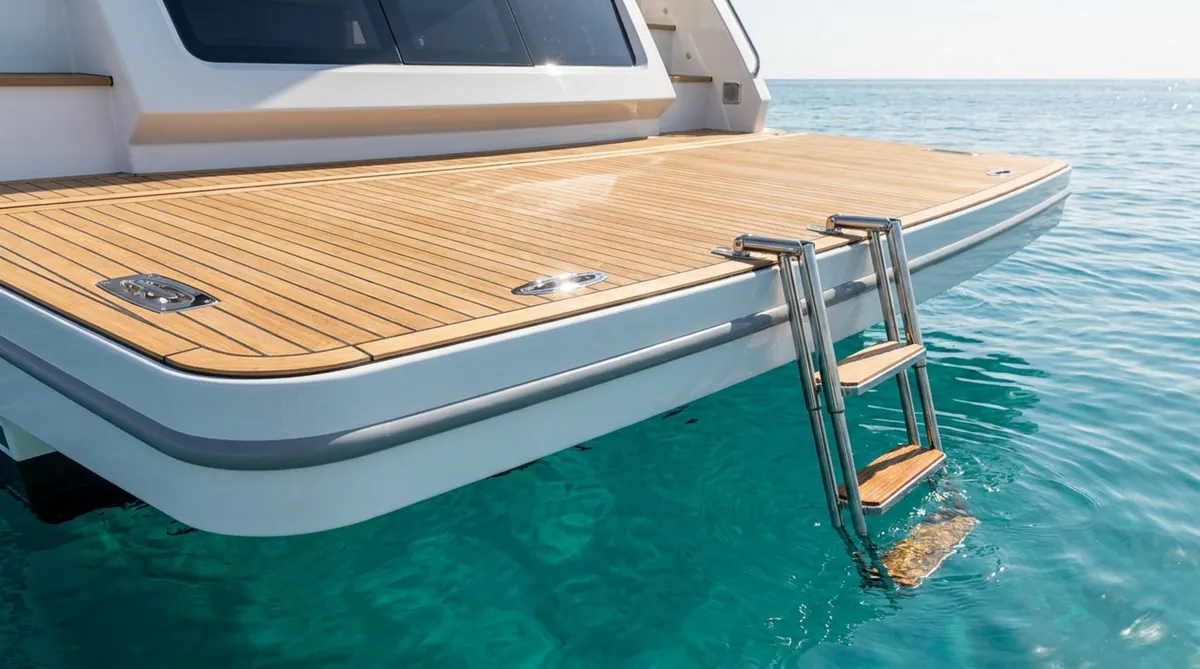
Aft swim platforms and boarding steps require specific engineering considerations. These structures reside in constant splash zones, experience frequent foot traffic, and absorb solar heat. Cored composite panels overlayed with synthetic marine decking offer the look of natural teak while minimizing cantilevered overhang mass at the stern.
How Much Do Lightweight Marine Deck Panels Cost Over Their Lifetime?
Evaluating initial procurement costs in isolation leads to inaccurate lifecycle estimates. The baseline price of unlaminated core materials or raw panels represents only a portion of the operational expenditure over the life of the vessel.
Labor for sealing, hardware mounting, installation, surface coating, and maintenance all factor into total cost. A low-cost material that requires replacement after several seasons can ultimately exceed the expense of an advanced composite deck built once.
Material, fabrication, transport, and installation costs
Standard marine plywood features a low purchase price, but demands intensive labor. Sanding, filleting, laminating, and sealing every edge against moisture requires significant workshop hours and resin consumables. Factory-laminated sandwich panels carry higher initial material costs, but they mount directly onto framing with structural adhesives, significantly reducing shipyard labor time.
Freight and yard handling also affect overall project economics. Dense, heavy sheet materials increase shipping costs and require cranes or multi-person crews to maneuver across the shipyard. Lightweight composite panels are readily positioned by two technicians, reducing assembly time and shop overhead during vessel outfitting.
Expected service life by material
Service longevity varies across material classes. Plywood decks subjected to saltwater and weathering often develop internal rot, localized soft spots, or delamination around fasteners within 8 to 12 years, despite careful initial sealing. Moisture penetration can quietly degrade the inner plies long before external damage becomes visible.
Properly consolidated fiberglass panels using closed-cell structural foam cores and marine aluminum systems consistently deliver 25 to 30 years of operational service without internal decay. Over multiple decades, non-rotting structural cores reduce lifecycle costs by avoiding extensive subfloor rebuilds and hull repairs.
What Should You Check Before Ordering Marine Deck Panels?
Accurate engineering specifications are necessary when ordering structural panels or foam cores. Inaccurate thickness or core density specifications can disrupt assembly tolerances and compromise structural calculations.
Providing the material supplier with precise dimensional, structural, and regulatory requirements ensures components integrate cleanly into the production line.
Panel dimensions, tolerances, and weight per square meter
Confirm the manufacturer’s dimensional tolerances, focusing on overall panel thickness, skin uniformity, and edge squareness. In composite sandwich assemblies, a thickness deviation of even ±1.0 mm can produce uneven steps at panel joints, requiring extra fairing labor prior to applying finishes. Working with suppliers that offer precision cutting and milling ensures exact fit-up.
Request verified weight-per-square-meter data rather than approximate figures. Small fluctuations in core density or resin-to-fiber ratios accumulate across broad deck areas. Verify skin aerial weight, resin type, and structural core density before ordering to keep naval architecture calculations accurate.
Load ratings, testing, and marine compliance
Confirm that the proposed sandwich structure has undergone standardized mechanical testing, including flexural tests (ASTM D790) and core shear evaluations (ASTM C273). These values confirm that the composite assembly will support anticipated deck loads over specified beam spans without exceeding allowable deflection limits.
For commercial passenger vessels, naval ships, and offshore craft, verify marine classification approvals. Organizations such as DNV, Lloyd’s Register, and the US Coast Guard maintain strict fire, smoke toxicity (IMO HSC rules), and mechanical safety criteria. Using certified structural cores guarantees regulatory compliance for critical maritime structures.
What Are the Maintenance and Safety Requirements?
Even closed-cell, rot-proof composite structures require regular inspection. Marine operating conditions subject panels to vibration, thermal cycling, and continuous load reversals that can stress mechanical fasteners and joint interfaces.
A systematic maintenance plan preserves surface coatings, detects hardware sealant breakdown early, and ensures the deck remains structurally sound.
Inspecting fasteners, seams, coatings, and core damage
Periodic visual inspections should target high-stress attachment zones, such as cleats, stanchions, winches, and radar arches. Inspect the gelcoat for spider cracking, check adhesive bond lines for movement, and look for degraded perimeter caulking that could allow water access behind the skins.
Subsurface flaws and bond delaminations can be identified using standard acoustic tap testing. Gently tapping the deck skin with a small phenolic or plastic hammer reveals internal structural conditions. A sharp, clear acoustic tone indicates a solid skin-to-core bond, whereas a dull, flat sound indicates local delamination, internal core crushing, or unbonded zones that require structural repair.
Preventing delamination, corrosion, rot, and slip hazards
Long-term reliability begins with appropriate marine bedding sealants. Avoid standard silicone formulations. Use high-performance polyurethane or polyether marine sealants around through-hull fittings and perimeter fasteners to prevent water intrusion. On aluminum assemblies, regularly verify that non-conductive isolation washers remain intact to avoid galvanic attack.
Traction maintenance is essential for operational crew safety. Non-skid walking surfaces must be cleaned regularly to prevent the accumulation of marine growth, diesel film, and salt crystals that reduce grip in wet seas. Whether utilizing molded diamond profiles, embedded aggregate textures, or resilient synthetic foam decking, maintaining clean, high-traction walking surfaces ensures safe vessel operation in all sea states.
Advanced composite engineering continues to drive improvements in maritime deck construction. Structurally efficient sandwich designs, precision-milled foam cores, and high-performance resins provide naval architects with the tools needed to build lighter, safer, and more fuel-efficient vessels. For specialized core selection and structural milling support, contact Chem-Craft to discuss material options for your composite manufacturing requirements.