
How do engineers maximize payload and flight time in eVTOL aircraft? By utilizing lightweight composite structures with high-performance structural foam cores, which significantly reduce vehicle mass while meeting strict aerospace engineering requirements for strength, thermal stability, and manufacturing process compatibility.…
How can aerospace engineers maximize payload capacity and durability in unmanned aerial vehicle (UAV) structures? Implementing high-performance structural foam cores, such as PMI (polymethacrylimide), enables the manufacturing of lightweight composite structures with exceptional thermal stability and mechanical strength. By minimizing…
How do composite engineers ensure thermal stability and structural integrity in EV battery enclosures? By selecting high-performance structural foam cores. Advanced materials like PMI foam provide the essential heat management, impact resistance, and lightweight structural performance required for modern composite…
How can composite engineers process ROHACELL® foam for high-precision prototyping? CNC machining, laser processing, and advanced molding methods provide the exact tolerances and surface finishes required for demanding aerospace, automotive, and medical applications. This technical guide covers the engineering requirements,…
How do structural foam cores influence antenna design? The dielectric properties of foam cores determine electromagnetic transparency, directly impacting antenna efficiency, bandwidth, and size. For composite engineers, selecting a core with the correct dielectric constant and loss tangent is a…
Why do composite parts manufactured with PMI foam cores experience unexpected weight variations? The primary cause is resin uptake, where liquid matrix materials penetrate the structural foam core’s surface cells during processing, adding significant mass without contributing to lightweight structural…
How do core thickness and density influence the performance of sandwich structures? In composite manufacturing, core thickness primarily dictates bending stiffness, while core density governs shear strength and localized load capacity. Balancing these two engineering requirements ensures lightweight structural performance…


How do structural foam cores reduce mass and increase stiffness in sports vehicles? By integrating advanced composite materials into hollow chassis sections, engineers transform empty cavities into load-bearing structures that significantly improve torsional stiffness and crash energy management without adding…


Why are original equipment manufacturers (OEMs) increasingly selecting structural foam cores for advanced lightweight composite structures? The demand is driven by the engineering requirement to balance significant weight reduction with superior thermal stability, strict flame-smoke-toxicity (FST) compliance, and manufacturing process…
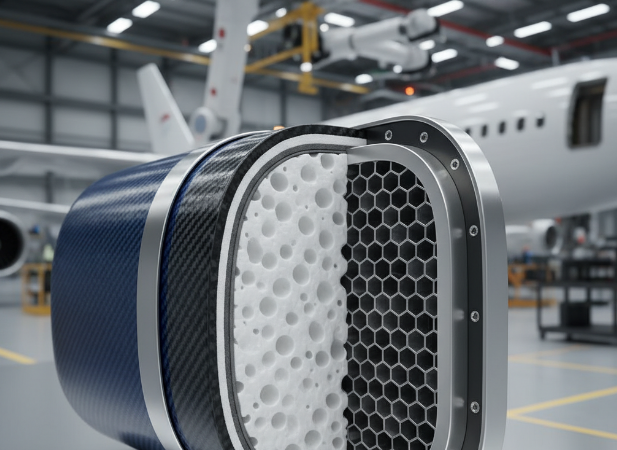

The aerospace industry has never been comfortable with compromise. Every gram added to an airframe eats into fuel economy, payload capacity, and operational range – yet every gram removed must not come at the cost of structural integrity. For decades,…