
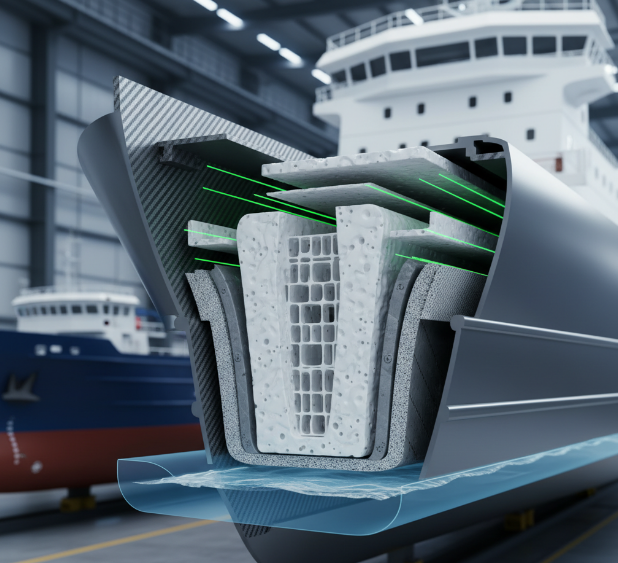
A ship is, at its core, a compromise between strength and displacement. Every kilogram of structural material above the waterline raises the centre of gravity. Every kilogram below it increases draft and wetted surface area. Naval architects have spent centuries managing this trade-off with steel and aluminium, and those metals still dominate – but the superstructure deck, the deckhouse, the mast enclosures, and increasingly the hull shell itself are becoming territory where composite sandwich construction makes an argument that metal cannot match.
The reasoning is not abstract. A composite superstructure can weigh 30 to 60 percent less than its aluminium equivalent, and that mass saving sits high on the vessel, exactly where its removal delivers the greatest benefit to stability. Lower topside weight means a lower centre of gravity, which translates directly into improved roll behaviour, greater reserve stability margins, and the ability to carry more payload or fuel without exceeding classification society limits.
Fuel Efficiency and the Economics of Displacement
Fuel is the single largest operating cost for most commercial vessels. Anything that reduces displacement – the total mass of the ship and everything on it – reduces the power required to push through water at a given speed. The relationship is not linear, but it is consistent: lighter ships burn less fuel.
For military vessels, the calculus is slightly different but points in the same direction. Reduced displacement at constant power means higher sprint speed. Alternatively, it means the same speed with smaller engines, freeing hull volume and weight budget for mission systems, weapons, or additional fuel for extended range. Surface combatants and patrol craft benefit enormously from composite superstructures because the weight savings are concentrated high and far from the keel, maximising the stability dividend.
The operational advantages of foam-cored composite construction in hull and superstructure applications include:
- Reduced displacement that lowers hydrodynamic resistance across all speed ranges, cutting fuel consumption for commercial operators and extending mission endurance for naval platforms.
- Improved transverse stability from shifting structural mass downward in the vessel’s profile, which allows greater freedom in topside arrangement and sensor placement without ballast penalties.
- Elimination of welding-induced distortion and residual stress that plague aluminium superstructures, producing fairer surfaces with better radar signature management – a factor of growing importance in modern naval design.
That last point – radar signature – has driven much of the military adoption of composite superstructures. A welded aluminium deckhouse is a collection of flat and curved metal panels that reflect radar energy efficiently back toward its source. A composite structure can be shaped and surfaced to scatter returns, and the core material itself plays a role in how electromagnetic energy interacts with the panel stack-up.
Durability in the Marine Environment
Saltwater is merciless on materials. Steel corrodes. Aluminium suffers galvanic attack when coupled with dissimilar metals or exposed to stagnant bilge water. Paint systems require constant maintenance, and coating breakdown in hidden spaces behind insulation and cable runs leads to structural degradation that goes undetected until survey inspections reveal it.
Composite sandwich panels sidestep much of this corrosion burden. The fibre-reinforced skins – whether glass, carbon, or aramid – are inherently resistant to saltwater. The resin matrix seals the laminate against moisture penetration. And the closed-cell foam core, assuming it has been properly bonded and edge-sealed, neither absorbs water nor provides a path for galvanic currents to flow.
This does not mean composite structures are maintenance-free. Impact damage from berthing operations, crane strikes, and dropped equipment can breach the outer skin and expose the core. However, the repair methodology for composites is well established in the marine industry, and localised repairs can be carried out without the hot work permits and fire watches that welded metal repairs demand – a significant practical advantage aboard operational vessels.
The long-term durability characteristics that matter most in marine composite construction are:
- Resistance to osmotic blistering in below-waterline applications, achievable through proper skin laminate design and the use of vinyl ester or epoxy resin systems rather than polyester.
- Fatigue performance under cyclic wave loading, where the viscoelastic behaviour of the foam core provides inherent damping that reduces stress concentrations at skin-to-core bond lines compared to rigid honeycomb constructions.
- Retention of mechanical properties after prolonged exposure to elevated temperature and humidity, which is relevant for vessels operating in tropical waters or for structures located near engine room boundaries.
Core material selection directly influences all three of these durability factors. A foam with inconsistent cell structure will have inconsistent mechanical properties, creating weak points that propagate under fatigue loading. A foam that absorbs even small amounts of water will gain mass over time and lose thermal insulation performance. Foams engineered with fine, uniform cell morphology and verified closed-cell content address these risks at the material level rather than relying entirely on processing quality to compensate.
Construction Methods for Shipyard Adoption
Shipyards are not composite workshops. The cultural and technical gap between steel fabrication and laminate lay-up is real, and bridging it requires manufacturing processes that are robust, scalable, and tolerant of the environmental conditions found in typical yard facilities – open sheds, variable temperature and humidity, and a workforce trained in welding rather than vacuum bagging.
Vacuum infusion has emerged as the dominant process for large marine composite structures precisely because it suits shipyard conditions. A single-sided mould, dry fabric reinforcement, and a foam core are assembled and sealed under a vacuum bag, and resin is drawn through the laminate by atmospheric pressure. The process is forgiving, produces consistent fibre volume fractions, and scales to hull panels measuring tens of square metres.
For this process to work efficiently, the core material must cooperate. Foam sheets need to conform to mould curvatures – either through thermoforming before placement or through scoring and bending on the mould surface. They must not crush under vacuum pressure. And critically, they must not absorb excessive resin through their cut edges and cell faces, because every gram of resin pulled into the core is a gram of added weight that contributes nothing to structural performance.
PMI foam grades designed for infusion processes – particularly those with ultra-fine cell structures – keep resin uptake to values that make a measurable difference on large panels. When a hull shell or superstructure panel measures fifty or a hundred square metres, the cumulative weight of resin absorbed into the core across that area can amount to tens of kilograms. Specifying a core material that reduces absorption from several hundred grams per square metre down to figures approaching 50 g/m² is not a marginal decision. It is a structural weight saving that compounds across every panel on the vessel.
Military Versus Commercial: Different Priorities, Same Physics
Commercial shipbuilders evaluate composite superstructures primarily through the lens of fuel savings, maintenance reduction, and construction speed. Naval programmes add signature management, blast resistance, and electromagnetic compatibility to the list. The core material serves both sets of requirements, but the emphasis shifts.
Blast and ballistic protection in naval composites depends on the energy absorption characteristics of the sandwich panel as a system. The skins resist penetration while the core absorbs energy through progressive crushing. A foam core with well-defined and repeatable crush behaviour – predictable plateau stress under dynamic compression – allows naval architects to design protective structures with confidence rather than relying on excessive safety margins that add weight back into the design.
Electromagnetic compatibility is equally critical. Modern warships bristle with sensors, communications systems, and electronic warfare equipment. The superstructure itself must not interfere with these systems. Metallic structures create reflections, standing waves, and shielding effects that complicate antenna placement and degrade system performance. A composite superstructure with carefully selected core materials can be designed as electromagnetically transparent in specific frequency bands, allowing antennas to be embedded within structural panels rather than mounted externally – a significant advantage for signature reduction and survivability.
The convergence point between commercial and military requirements is telling. Both communities want lighter structures. Both want lower maintenance costs. Both want manufacturing processes that deliver consistent quality at production rates that keep pace with build schedules. The physics of composite sandwich construction serves these shared goals, and the foam core sitting between the skins is where much of the performance is won or lost. Choosing the right grade, density, and cell structure for each application is engineering, not marketing – and the data increasingly supports PMI foams as the answer to questions that both communities are asking with growing urgency.