
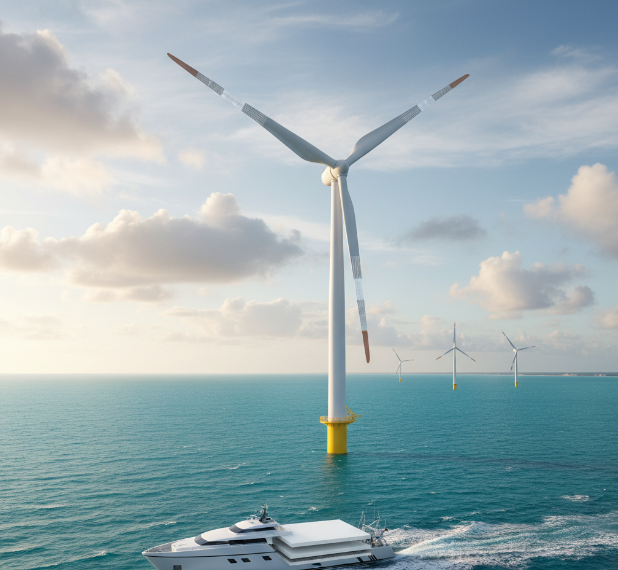
The global shift toward sustainable energy and the increasing demands of the maritime sector have catalyzed a revolution in material science. As industries strive for greater efficiency, durability, and performance, traditional materials like heavy metals and standard polymers are being replaced by advanced composite solutions. At the forefront of this evolution are the high-performance sandwich core materials developed by Evonik: ROHACELL® and ROHACRYL®. These materials, distributed by CHEM-CRAFT, have become indispensable in the production of lightweight, high-strength components for offshore wind turbines and high-speed marine vessels.
The Evolution of Lightweighting in Harsh Environments
In both the marine and renewable energy sectors, the primary challenge is balancing structural integrity with weight reduction. In the marine industry, reducing the weight of a vessel’s superstructure or hull translates directly into higher speeds, increased fuel efficiency, and greater payload capacity. In the renewable energy sector, particularly in wind power, the length and weight of turbine blades are critical factors; lighter blades can be made longer, capturing more wind energy without putting excessive strain on the turbine’s internal bearings and gearbox.
ROHACELL® PMI (polymethacrylimide) foams represent a unique class of polymer foam sheets. Unlike standard cores, they offer a superior strength to weight ratio that allows engineers to design thinner, lighter sandwich structures that do not compromise on safety or longevity. This is particularly vital in offshore environments where components are subjected to constant salt spray, UV radiation, and mechanical fatigue.
When we examine the structural requirements of a modern catamaran or a racing yacht, the core material must act as more than just a spacer between fiberglass skins. It must resist shear forces and provide enough stiffness to prevent the hull from flexing under the rhythmic pounding of waves. Similarly, in wind energy, the shear web of a turbine blade—the internal “I-beam” that provides the blade’s primary structural support—relies on the core material to maintain its shape under immense centrifugal force.
Why Material Choice Matters in Marine Engineering
The marine environment is perhaps one of the most demanding settings for any structural material. Components must resist water ingress, withstand hydrostatic pressure, and maintain their shape under the rhythmic pounding of waves. This is where the specific cell structure of Evonik’s foams provides a competitive edge.
The use of a closed-cell foam is non-negotiable in maritime applications. If the core material were to absorb water, the vessel would gain weight rapidly, losing its speed and fuel efficiency. Furthermore, water ingress can lead to internal rot or delamination, which can cause catastrophic structural failure. ROHACRYL™ SW is particularly ideal for lightweight sandwich construction because it remains impervious to moisture while offering the mechanical stiffness required for high-performance hulls.
Key Performance Benefits for Marine Vessels:
- Buoyancy Maintenance: The closed-cell structure prevents water wicking even if the outer composite skin is breached.
- Vibration Damping: The polymer structure naturally absorbs acoustic energy, making for quieter cabin environments in luxury yachts.
- Thermoformability: Materials can be shaped into complex hydrodynamic curves without losing structural integrity.
ROHACELL® in the Renewable Energy Sector
As the world transitions to green energy, wind power has emerged as a cornerstone of the renewable landscape. The engineering of wind turbine blades is a feat of modern physics, requiring materials that can withstand extreme centrifugal forces and environmental stressors for decades.
The use of ROHACELL® and ROHACRYL® in wind blade construction focuses on the “sandwich” principle. By placing a lightweight core between two skins of carbon fiber or fiberglass, manufacturers create a component that is incredibly stiff yet remarkably light. This method is essential for the latest generation of offshore turbines, which feature blades exceeding 100 meters in length. One of the most significant advantages of using ROHACELL® in wind energy is its high thermal performance and stability. During the manufacturing process, particularly when using advanced resin systems, the core must withstand high temperatures and pressures without collapsing or deforming.
In high-volume wind energy production, efficiency is measured not just in the performance of the blade, but in the speed of the manufacturing cycle. Because ROHACRYL® can withstand processing temperatures up to 120°C, manufacturers can utilize faster-curing resins, which leads to an increased production speed and lower overall energy consumption during the curing phase.
Technical Superiority and Processing Advantages
What truly sets ROHACELL® apart from other sandwich cores is its behavior during the infusion and curing stages. In modern composite manufacturing, vacuum infusion and RTM (Resin Transfer Molding) are the standard for producing high-quality parts. During these processes, the core material is subjected to a vacuum and then “wetted” with resin.
A common problem with traditional foams is high resin uptake. If the cells of the foam are too large or open, the resin seeps into the core, adding unnecessary weight and cost. ROHACELL® RIMA and ROHACRYL® SW are designed with a very low resin uptake in mind. By keeping the resin on the surface, manufacturers can save hundreds of grams per square meter. This is why commonly used grades of PMI are preferred for large-scale projects; the cost savings on resin alone can justify the use of higher-end core materials.
Why Renewable Energy Manufacturers Choose ROHACELL®:
- Compressive Creep Resistance: The material does not shrink or deform under the pressure of vacuum bagging or autoclave cycles.
- Fatigue Life: These foams exhibit excellent mechanical properties over millions of cycles, ensuring turbine blades last for 25+ years.
- Consistency: The homogeneous cell structure ensures that every square meter of the blade has the same weight and strength.
The Role of CHEM-CRAFT as a Technical Partner
Choosing the right grade of foam is only half the battle; understanding how to process it is equally important. This is where CHEM-CRAFT provides immense value to the industry. As the leading supplier of ROHACELL® and ROHACRYL® in Nordic Europe, Eastern Europe, and the BeNeLux countries, CHEM-CRAFT is more than just a distributor.
The team consists of composite engineers who are experts in hand lay-up, RTM, infusion, and autoclave processes. They provide technical support and consulting to ensure that marine and energy companies maximize the benefits of Evonik’s high-performance foams. Whether it is selecting a specific density for a sub-sea housing or optimizing the infusion strategy for a 120-meter turbine blade, CHEM-CRAFT ensures that the material matches the specific technical requirements of the application.
Conclusion
The future of marine and renewable energy depends on the continued development of lightweight, durable materials. ROHACELL® and ROHACRYL® foams have proven themselves to be the gold standard in these industries, offering a combination of thermal stability, mechanical strength, and low resin uptake that is unmatched by traditional core materials.
By leveraging the expertise of CHEM-CRAFT and the innovation of Evonik, manufacturers can push the boundaries of what is possible, creating faster ships and larger, more efficient wind turbines that will drive the global economy and the green energy transition forward. With short lead times and low minimum order values, CHEM-CRAFT makes these advanced materials accessible to innovators across the European continent, ensuring that the next generation of composite engineering is built on a foundation of excellence. Through constant innovation and a commitment to technical support, the partnership between material science and heavy industry continues to reach new heights, quite literally, in the case of the world’s most powerful wind turbines.