
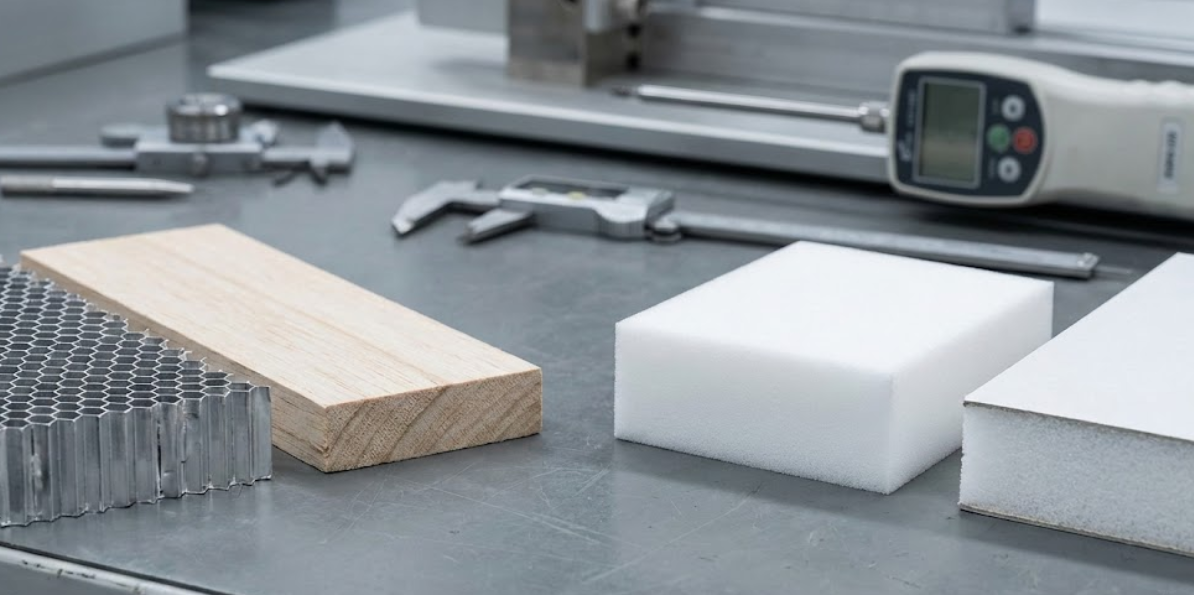
Material selection in composite engineering has never been straightforward. Every project brings its own matrix of requirements—weight targets, mechanical loads, thermal environments, production volumes, budget constraints—and the “right” material emerges from navigating trade-offs that rarely resolve cleanly. For decades, engineers choosing core materials for sandwich construction worked within a familiar landscape of options: aluminum honeycomb, Nomex honeycomb, balsa wood, PVC foams, and various other polymer foams. Each had known strengths and documented limitations.
ROHACELL® polymethacrylimide foam entered this landscape as something genuinely different. Not merely another foam option competing on incremental property improvements, but a material system that fundamentally changes the trade-off calculations engineers have traditionally accepted. Understanding where ROHACELL® outperforms conventional alternatives—and where those alternatives might still make sense—requires honest comparison across the dimensions that actually matter in engineering practice.
Weight Efficiency: The Core Metric
Sandwich construction exists primarily to achieve stiffness and strength at minimum weight. The core material’s job is to maintain separation between face sheets while resisting shear loads, and to do so without adding unnecessary mass. By this fundamental metric, ROHACELL® delivers performance that most traditional materials cannot match.
Consider the comparison with aluminum honeycomb, long the default choice for aerospace applications demanding maximum stiffness-to-weight ratios. Aluminum honeycomb achieves excellent performance in pure shear, but brings limitations that ROHACELL® avoids:
- Honeycomb cells can fill with water in service, adding weight and promoting corrosion
- The open-cell structure provides no inherent thermal or acoustic insulation
- Complex curved geometries require expensive forming operations or result in cell distortion
- Bonding to face sheets demands careful surface preparation and adhesive selection
ROHACELL®’s closed-cell structure eliminates moisture intrusion concerns entirely. The foam’s inherent resistance to water absorption means panels maintain their designed weight throughout service life, even in humid or wet environments that would compromise honeycomb performance over time.
Against balsa wood—another traditional lightweight core with a long history in marine and wind energy applications—ROHACELL® offers consistency that natural materials cannot guarantee. Balsa density varies with growth conditions, and the material’s properties are directional in ways that complicate structural analysis. ROHACELL® delivers uniform, predictable properties across production lots, simplifying qualification and reducing the safety factors engineers must apply to account for material variability.
Thermal Performance Comparison
Processing temperature capability separates materials into distinct application tiers. Many traditional foam cores—PVC foams, PET foams, standard polyurethane foams—soften at temperatures that limit their use with high-performance resin systems requiring elevated cure temperatures. This constraint forces engineers into compromises: either accept the cycle time penalties of low-temperature curing, or select more expensive core materials.
ROHACELL® XT grades can withstand curing temperatures up to 180°C and pressures up to 0.45 MPa, with heat-treated variants extending to 190°C and 0.7 MPa. Even standard ROHACELL® IG-F handles 130°C processing that exceeds most PVC foam capabilities. This thermal headroom enables:
- Use of faster-curing prepreg systems that reduce production cycle times
- Compatibility with BMI and other high-temperature resin chemistries
- Processing flexibility that accommodates various manufacturing approaches
- Service temperature capability for applications near heat sources
The high-temperature resistance reaching 200°C in service for certain ROHACELL® grades opens applications—aerospace structures near engines, automotive components in engine compartments, industrial equipment subject to process heat—where PVC or PET foams simply cannot perform.
Mechanical Property Comparison
Raw strength and stiffness numbers favor ROHACELL® against most foam alternatives at equivalent densities. But the more meaningful comparison involves how efficiently each material converts its weight into structural performance. ROHACELL®’s PMI chemistry delivers a superior strength-to-density ratio that exceeds what PVC, PET, or polyurethane foams achieve.
The comparison with honeycomb materials is more nuanced. Aluminum and Nomex honeycomb can match or exceed ROHACELL® in pure shear performance at very low densities. However, honeycomb’s directional properties mean that performance in one loading direction often comes at the cost of weakness in others. ROHACELL®’s isotropic behavior—similar properties regardless of loading direction—simplifies structural analysis and provides more predictable performance under complex, multi-directional loading.
Fatigue performance further distinguishes ROHACELL® from alternatives. The PMI foam maintains its properties under cyclic loading in ways that some competing materials do not:
- PVC foams can develop microcracks under repeated loading that propagate to failure
- Balsa wood’s fatigue behavior varies with moisture content and grain orientation
- Honeycomb core-to-face-sheet bonds represent potential fatigue initiation sites
ROHACELL®’s excellent dynamic strength makes it the preferred choice for applications like helicopter rotor blades and wind turbine components where fatigue life determines service intervals and lifecycle costs.
Processing and Manufacturing Considerations
Material selection doesn’t happen in isolation from manufacturing reality. A core material that looks ideal on paper but creates production problems delivers less value than its specifications suggest. ROHACELL® compares favorably against traditional materials across multiple processing dimensions.
Thermoformability gives ROHACELL® advantages over rigid honeycomb structures for complex geometries. While honeycomb requires specialized forming equipment and careful process control to avoid cell crushing, ROHACELL® can be thermoformed into compound curves using relatively straightforward tooling. This capability reduces both tooling investment and per-part processing costs for geometrically complex components.
Machinability matters for applications requiring precise core geometries or integration of inserts and hardpoints. ROHACELL® machines cleanly with standard CNC equipment, producing accurate features without the cell tear-out that can plague honeycomb machining or the dust management challenges associated with balsa. The compatibility with standard processing equipment lowers adoption barriers for manufacturers evaluating ROHACELL® for new applications.
Resin compatibility spans the range of thermoset systems used in composite manufacturing. Unlike some foams that react with certain resin chemistries or outgas during cure, ROHACELL® maintains stability with epoxy, BMI, phenolic, and other common matrix materials. This broad compatibility simplifies material qualification and allows engineers to optimize resin selection independently of core material constraints.
Cost-Performance Analysis
ROHACELL® commands premium pricing relative to commodity foam cores like PVC and PET. The honest comparison acknowledges this reality while examining whether the premium delivers proportionate value. In many applications, the answer is clearly yes—and the economic case extends beyond raw material cost to encompass system-level benefits.
Weight savings translate directly to value in aerospace and automotive applications where each kilogram carries quantifiable cost implications. When ROHACELL® enables a design that saves 5 kg compared to PVC foam construction, and that weight saving delivers fuel savings over a 20-year aircraft service life, the material premium becomes trivial relative to lifecycle value.
Production efficiency gains similarly offset material costs. Faster cure cycles enabled by ROHACELL®’s thermal stability increase facility throughput. The foam’s consistent properties reduce scrap rates and rework. Its thermoformability eliminates secondary forming operations required with honeycomb. Properly accounted, these factors often make ROHACELL® the most economical choice on a total-cost basis despite higher per-kilogram pricing.
For applications where ROHACELL®’s premium properties aren’t fully utilized, ROHACRYL® offers an alternative that delivers many of the same benefits at price points competitive with traditional foams. The availability of both PMI and acrylic foam options from the same supplier allows engineers to right-size material selection to application requirements.
When Traditional Materials Still Make Sense
Intellectual honesty requires acknowledging that ROHACELL® isn’t universally superior. Applications exist where traditional materials remain appropriate choices.
Very high-volume, cost-driven applications with modest performance requirements may favor commodity PVC or PET foams. If thermal stability beyond 80°C isn’t needed, if fatigue loading is minimal, and if weight optimization isn’t critical, the economic case for ROHACELL® becomes harder to make.
Applications requiring unusual core thicknesses or densities outside ROHACELL®’s standard range might find better solutions in materials with broader availability. And some legacy applications with established material qualifications face regulatory or customer barriers to material substitution regardless of technical merit.
Making the Right Choice
The comparative landscape has shifted substantially with ROHACELL® and ROHACRYL® establishing new performance benchmarks. Traditional materials that once represented acceptable compromises now look increasingly dated against PMI and acrylic foam alternatives that deliver genuine advancement in core material capability.
Engineers approaching material selection today benefit from options their predecessors lacked. The decision isn’t whether ROHACELL® outperforms traditional materials—in most relevant metrics, it does. The decision is whether a specific application’s requirements justify accessing that performance, and whether the total-cost economics favor the premium material. Increasingly, across industries from aerospace to automotive to renewable energy, the answer is yes.