
How do engineers maximize payload and flight time in eVTOL aircraft? By utilizing lightweight composite structures with high-performance structural foam cores, which significantly reduce vehicle mass while meeting strict aerospace engineering requirements for strength, thermal stability, and manufacturing process compatibility.…
How can composite engineers process ROHACELL® foam for high-precision prototyping? CNC machining, laser processing, and advanced molding methods provide the exact tolerances and surface finishes required for demanding aerospace, automotive, and medical applications. This technical guide covers the engineering requirements,…
How do structural foam cores influence antenna design? The dielectric properties of foam cores determine electromagnetic transparency, directly impacting antenna efficiency, bandwidth, and size. For composite engineers, selecting a core with the correct dielectric constant and loss tangent is a…
How do core thickness and density influence the performance of sandwich structures? In composite manufacturing, core thickness primarily dictates bending stiffness, while core density governs shear strength and localized load capacity. Balancing these two engineering requirements ensures lightweight structural performance…


w ramach Programu Fundusze Europejskie dla Pomorza 2021-2027, Priorytetu FEPM.01 Fundusze europejskie dla konkurencyjnego i inteligentnego Pomorza, Działania FEPM.01.01 Badania i innowacje w przedsiębiorstwach, współfinansowanego z Europejskiego Funduszu Rozwoju Regionalnego . Fundusze Europejskie Dla Pomorza 2021-2027


How can composite engineers reduce the carbon footprint of demanding industrial applications without sacrificing structural integrity? Integrating high-performance structural foam cores into sandwich construction optimizes stiffness-to-weight ratios and provides thermal stability, directly lowering lifecycle greenhouse gas emissions. A full lifecycle…

Why are original equipment manufacturers (OEMs) increasingly selecting structural foam cores for advanced lightweight composite structures? The demand is driven by the engineering requirement to balance significant weight reduction with superior thermal stability, strict flame-smoke-toxicity (FST) compliance, and manufacturing process…


Yacht construction has always attracted materials that promise more with less. Carbon fibre replaced glass in racing hulls. Nomex honeycomb replaced plywood in deck panels. Vacuum infusion replaced hand lay-up in production yards. Each transition followed the same pattern: resistance…
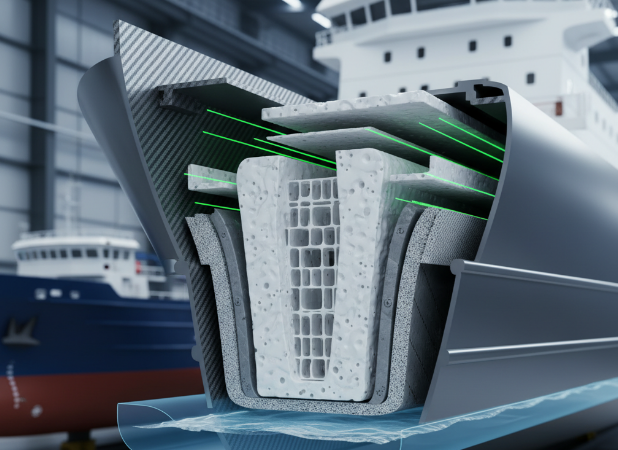

A ship is, at its core, a compromise between strength and displacement. Every kilogram of structural material above the waterline raises the centre of gravity. Every kilogram below it increases draft and wetted surface area. Naval architects have spent centuries…


Rail transport occupies an unusual position in the materials conversation. Unlike aerospace, where every gram is tracked with near-obsessive precision, the rail sector has historically been more tolerant of mass. Steel and aluminium have dominated carriage construction for over a…