How does lead time affect composite production planning? Lead time sets raw material ordering schedules, dictates thermal equipment availability, and prevents perishable resins from exceeding their validated out-time limits. Accurate scheduling ensures that core materials, prepregs, and tooling align precisely before irreversible curing cycles begin.
Production control in composite manufacturing differs from conventional metal machining or mechanical assembly. Metals can remain in storage indefinitely until machine capacity opens, and flawed welds can often be ground out and repaired. Advanced composite manufacturing relies on chemically active, temperature-sensitive materials that operate under strict out-life limits. Tools demand precise thermal preparation, and autoclave or resin infusion cure profiles are irreversible. For these reasons, mapping lead time across every stage of the manufacturing sequence is critical for maintaining process stability, structural integrity, and schedule reliability.
1. What Is Lead Time in Composite Production Planning?
In composite manufacturing, lead time represents the total duration from the initial release of an activity to its verified completion. The operational scope changes based on whether you evaluate material procurement, cleanroom processing, or final customer delivery. At its fundamental level, lead time encompasses every working hour and queue period required to convert an engineering model into a fully inspected, structurally sound composite part.
Production planners must treat lead time as a cumulative system of interdependent intervals. It includes active processing on the shop floor as well as necessary dwell periods. Material thawing, adhesive degassing, autoclave cooling, post-curing, and non-destructive inspection all consume production time. Omitting passive stabilization periods leads directly to production delays and unreliable schedules.
How Lead Time Differs from Cycle Time, Takt Time, and Throughput Time
A common error in composite scheduling is treating lead time as identical to cycle time, takt time, or throughput time. Cycle time measures the duration required to complete a single discrete operation under standard conditions. For example, an automated ply cutter may require three hours to nest and cut a prepreg carbon fiber kit for an aerospace panel. Cycle time accounts only for active machine processing, excluding handling, staging, and inspection queues.
Takt time defines the pace of production required to meet customer demand, calculated by dividing net available production time by the required delivery volume. Throughput time tracks an individual unit from the initial release of raw materials through final transfer to finished goods inventory. Lead time provides the broadest perspective. From the customer or procurement standpoint, it incorporates supplier quotation times, material lot synthesis, testing, cleanroom staging, non-destructive testing (NDT), and packaging verification.
Which Lead Times Shape a Composite Manufacturing Schedule?
A master composite manufacturing schedule is governed by three primary lead time categories:
- Procurement Lead Time: The duration between purchase order placement and receipt of certified reinforcements, matrix systems, structural foam cores, and vacuum consumables.
- Manufacturing Lead Time: The active span required to convert raw materials into cured, demolded, trimmed, and coated composite structures. This encompasses ply cutting, sandwich core staging, cleanroom lay-up, debulking, curing, and CNC machining.
- Quality and Release Lead Time: The time dedicated to ultrasonic non-destructive testing, coordinate measuring machine (CMM) dimensional verification, destructive coupon testing, and quality document release.
Excluding any single phase destabilizes the critical path. If a planner allocates four weeks for manufacturing lay-up and curing but overlooks three weeks needed for post-cure coupon testing and customer source inspection, the finished component will remain grounded while downstream assembly lines stall.
How to Calculate Total and Cumulative Lead Time
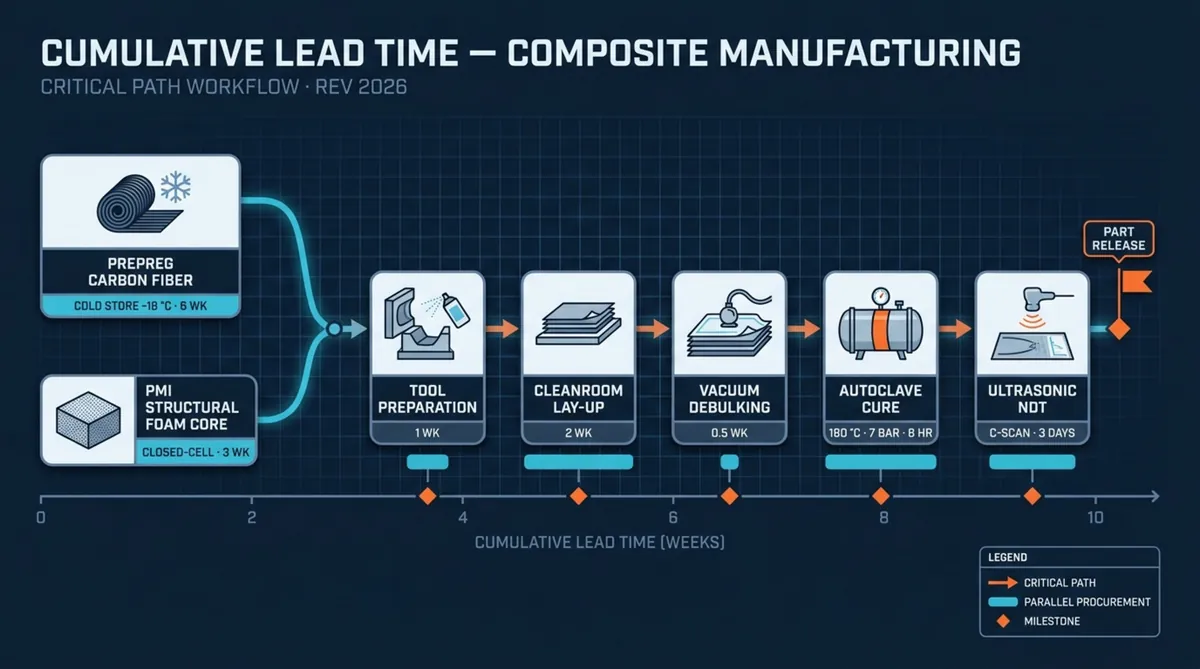
Lead time calculations in composite production must distinguish between sequential tasks and parallel processes. Total lead time represents the arithmetic sum of every discrete task assigned to a work package. Cumulative lead time, or critical path lead time, measures the longest continuous chain of dependent activities from raw material synthesis to customer handoff.
The standard formula for cumulative lead time is:
Cumulative Lead Time = Longest Procurement Lead Time + Tool Preparation Time + Manufacturing Lead Time + Quality Assurance and Release Time
Consider a carbon fiber radome utilizing sandwich construction. If a high-performance structural core requires twelve weeks for delivery and the prepreg fabric requires six weeks, the core procurement dictates the critical path. Planners must schedule material releases to prevent prepreg from arriving prematurely and expiring in cold storage while waiting for core materials.
2. Why Lead Time Matters for Composite Manufacturing
Lead time directly affects operating costs and working capital in composite fabrication. Advanced composite facilities handle high-value prepregs, reactive resins, and specialized structural foam cores. Accurate lead time planning prevents cleanrooms from becoming bottlenecks and avoids turning staging areas into uncontrolled storage for unfinished parts.
When engineering teams integrate accurate lead times into production schedules, facilities maintain steady capacity utilization. Specialized cleanroom technicians receive kitted plies on schedule, thermal equipment runs at full batch capacity, and work-in-progress (WIP) levels remain low. Inaccurate estimates lead to cleanroom stoppages, expediting fees, and compressed margins.
How Lead Time Sets Customer Delivery Dates
Industries such as aerospace, defense, marine, and automotive operate under strict just-in-time delivery requirements. When an aircraft manufacturer orders composite control surfaces, those components must arrive precisely within the designated assembly window. A delayed shipment can interrupt high-value final assembly operations.
Accurate lead time modeling allows planning teams to establish achievable delivery milestones during project initiation. Basing a contract on ideal cycle times while ignoring material incoming inspection, tool prep, or thermal soak cycles creates high delivery risks. Reliable lead time projections preserve supplier performance ratings and ensure contractual compliance.
How Delays Create Ripple Effects Across the Production Plan
In conventional assembly, a delayed workstation can often be bypassed by reassigning technicians to alternate benches. In composite manufacturing, processes follow strict, irreversible chemical and physical sequences. If vacuum bagging on a tool falls behind schedule by two hours, the component misses its assigned autoclave or oven run.
Missing a curing window initiates cascading schedule failures. The autoclave must either cycle partially empty, raising unit processing costs, or wait for the lagging tool, delaying subsequent production shifts. Meanwhile, prepreg materials laid onto tools continue to consume their validated cleanroom out-life. A minor delay at the lay-up table can immobilize shared tooling, waste thermal equipment capacity, and compromise the processing compatibility of active materials.
3. The Lead Times That Affect Composite Production Planning
A comprehensive composite schedule consists of distinct procurement, preparation, and fabrication phases. Each phase presents specific technical requirements, storage constraints, and processing variables that must be tracked within the production control system.
Treating composite manufacturing as a single uninterrupted flow obscures operational bottlenecks. Stable production planning requires granular control over raw material procurement, mold availability, cleanroom lay-up, and secondary finishing operations.
Raw Material and Reinforcement Procurement Lead Time
High-modulus carbon fibers, structural glass, and aramid fabrics often have extended procurement timelines. Producing woven architectures, multiaxial non-crimp fabrics, and unidirectional tapes requires tight quality controls and dedicated supply chains. Lead times for these reinforcements can range from several weeks to months depending on specification requirements.
Structural foam cores also require deliberate procurement planning. Closed-cell materials such as polymethacrylimide (PMI) foam must meet precise engineering requirements for density, cell structure, and thermal stability. Sourcing specialized structural cores-such as ROHACELL® PMI foam-requires clear lead time visibility. When manufacturers require custom dimensions, utilizing pre-cut sheets via tight-tolerance horizontal cutting significantly shortens preparation time on the shop floor. Standardizing material procurement helps secure inventory before manufacturing releases occur.
Resin, Adhesive, and Consumable Lead Time
Thermoset prepregs, epoxy infusion resins, and structural adhesives involve specialized handling and cold-chain logistics. Pre-impregnated materials require continuous refrigerated transport and storage, typically at -18°C or below, accompanied by calibrated temperature-logging sensors to verify chemical stability upon arrival.
Composite processing also demands a steady supply of specialized consumables. High-temperature nylon bagging films, release films, peel plies, sealant tapes, and breathers must align with processing temperatures. A shortage of a specific bagging film can halt autoclave production as completely as the absence of structural reinforcement.
Tooling, Mold, and Fixture Lead Time
Molds and fixtures establish the physical geometry and thermal performance of composite structures. Facilities use low-expansion Invar 36 tooling for tight tolerances, machined aluminum molds for medium-rate manufacturing, or high-temperature composite tooling. Designing, machining, leak testing, and thermal survey mapping for new molds often requires more time than the production run itself.
For existing production tools, routine maintenance must be factored into scheduling. Molds require regular thermal cycling verification, mechanical alignment checks, surface cleaning, and the application and curing of semi-permanent release agents. Sourcing precision tooling-such as custom RTM mold milling-early in development prevents tool readiness delays from extending project timelines.
Manufacturing and Layup Lead Time
The cleanroom lay-up environment concentrates high levels of manual labor and automated processing. Manufacturing lead time includes material retrieval from freezers, sealed thawing, precision kit cutting, and automated or manual ply deposition. Frozen prepregs typically require 12 to 24 hours of sealed staging to prevent atmospheric moisture condensation, which can cause internal porosity during cure.
Lay-up schedules must also account for intermediate consolidation. Thick laminates and structural sandwich panels require periodic vacuum debulking-typically 15 to 30 minutes every few plies-to remove entrapped air and prevent ply wrinkling. These debulk cycles represent necessary process steps that cannot be bypassed without risking laminate voids and structural integrity issues.
Cure, Demold, Trim, and Finishing Lead Time
Once vacuum bagged, composite assemblies enter the thermal curing stage. Cure cycle duration is governed by resin kinetics and thermal transfer rather than labor input. A typical aerospace autoclave cycle includes controlled ramp rates, thermal soaks, and controlled cooling periods that span six to sixteen hours to avoid internal thermal stresses.
Following demolding, parts move to post-cure finishing operations. These include 5-axis CNC edge trimming, precision drilling, surface preparation, non-destructive testing, and coating application. Primers, topcoats, and edge sealants also require dedicated cure and drying intervals before parts can be packaged for shipment.
4. How Lead Time Affects the Composite Production Schedule
Every operational constraint in a composite facility asserts itself through time. Integrating verified lead times into capacity planning systems defines the realistic operating rhythm of the plant and reveals true production limits.
Production scheduling balances sequential and parallel steps across the factory. When purchasing schedules, material preparation, cleanroom lay-up, and curing cycles drift out of alignment, queue times increase, tooling sits idle, and work-in-progress inventory builds up across the floor.
How Procurement Lead Time Determines the Material Release Date
Material Requirements Planning (MRP) systems use procurement lead times to establish purchasing milestones and shop-floor release dates. Working backward from the target delivery milestone, the planning software calculates the precise dates when resins, structural cores, and dry reinforcements must be ordered.
Underestimating procurement lead times causes material shortages, forcing automated cutting tables and lay-up technicians to sit idle. Overestimating procurement lead times causes premature delivery of perishable prepregs, which fills cold-storage freezers and risks material expiration before processing begins.
How Cure and Equipment Lead Time Limit Production Capacity
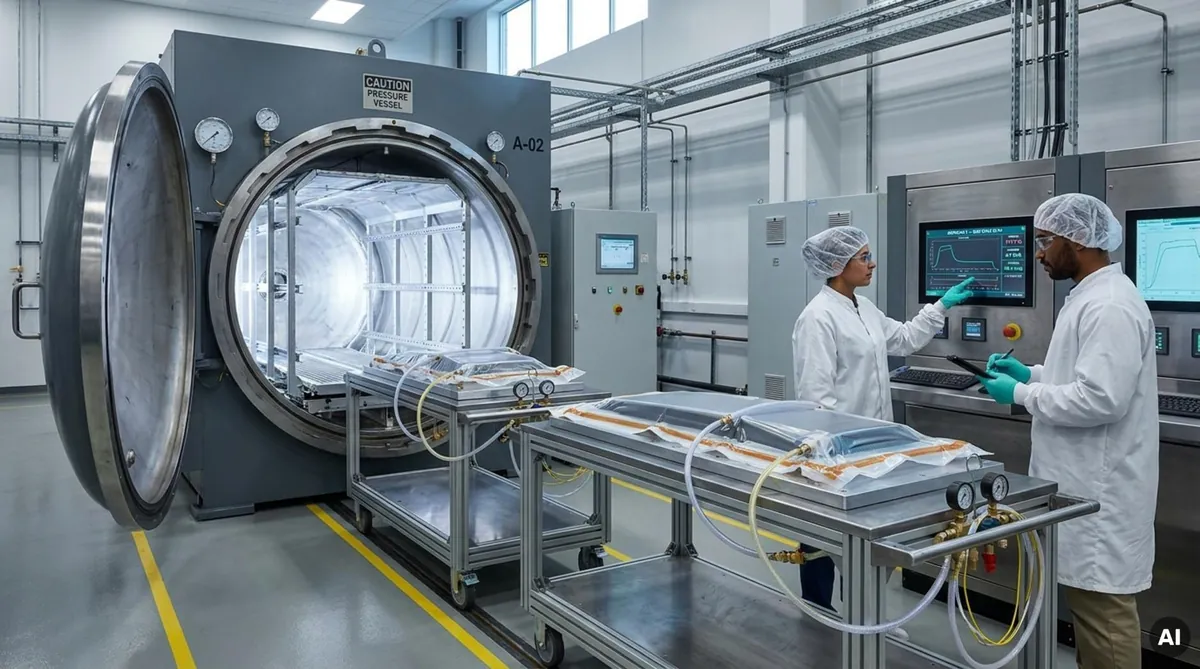
In most composite manufacturing operations, thermal curing equipment represents the primary operational bottleneck. High-pressure autoclaves, composite curing ovens, and heated hydraulic presses require major capital investment and operate with fixed internal volumes. Their cycles cannot be accelerated arbitrarily without compromising resin cross-linking.
Curing cycles are determined by strict engineering requirements. Daily facility capacity is governed by the number of thermal cycles that can be completed and how efficiently parts can be nested within a single load. Planners must group parts that share compatible cure profiles, ramp rates, and consolidation pressures. If a tool scheduled for an autoclave load is delayed, the entire cure cycle may be postponed, cutting facility throughput for that shift.
How Bottlenecks Change the Critical Path
In complex assemblies, such as aircraft wing panels or automotive monocoques, numerous subcomponents must merge on the main assembly line. The critical path represents the sequence of dependent steps that dictates the minimum completion time for the overall structure.
Process variations quickly shift the critical path. A cutting table breakdown or an extended ultrasonic scan on a complex contoured shape immediately moves the bottleneck to an unexpected work center. Planners must actively track work-in-progress to reallocate personnel and tooling before schedule deviations reach final inspection.
5. How Lead Time Variability Creates Planning Risk
Long lead times present operational challenges, but unpredictable lead times introduce far greater manufacturing risk. A stable sixteen-week procurement timeline can be integrated into an efficient production schedule. A supply line that fluctuates unpredictably between eight and twenty weeks forces facilities to adopt inefficient operational habits.
Lead time variability leads to excess safety stock, uneven shop-floor workloads, and compromised labor utilization. Because composite manufacturing relies on strict process windows and temperature-controlled storage, supply interruptions quickly cascade across the entire facility.
What Causes Lead Time Variability in Composite Manufacturing?
Lead time variations in composite fabrication typically stem from supply chain fluctuations and strict cleanroom parameters:
- Material Shelf Life and Recertification: Out-of-date prepregs or resin systems require comprehensive physical and mechanical testing before use, introducing unexpected testing delays.
- Batch-to-Batch Chemistry Variations: Slight changes in resin viscosity, tack, or volatile content between chemical lots can require adjustments to debulk cycles or thermal cure ramps.
- Cleanroom Environmental Fluctuations: If cleanroom temperature or humidity levels drift outside validated processing windows, lay-up must stop immediately to prevent moisture entrapment in the laminate.
- Specialized Core Processing: Delays in core edge chamfering, thermoforming, or localized potting can hold up sandwich panel lay-up even when skin materials are ready.
How Quality Failures, Rework, and Scrap Extend Lead Time
In standard metal fabrication, minor dimensional discrepancies can often be resolved with straightforward machining. Composite defects require detailed engineering reviews. If ultrasonic NDT reveals internal delamination, core crush, or void content exceeding allowable limits, standard finishing must halt immediately.
Resolving composite defects requires formal non-conformance reports (NCR), material review board evaluations, and validated repair protocols. Executing a stepped scarf repair involves precision ply grinding, wet-layup or prepreg replacement, vacuum debulking, and localized hot-bonder cure cycles. This process can add several weeks to the manufacturing lead time of an individual part.
6. How to Build Lead Time into Composite Production Planning
An effective composite production plan treats lead time as an active variable based on empirical shop-floor performance rather than ideal cycle estimates. Engineering and planning teams must implement scheduling models that reflect physical manufacturing limits while minimizing queue delays.
Establishing this control requires end-to-end process mapping, robust historical data tracking, and disciplined backward scheduling.
Map the End-to-End Material and Production Flow
Before optimizing a production schedule, teams must document the complete manufacturing sequence for each composite part. The process map should trace both material flow and data transfer, from raw material synthesis to customer sign-off.
The map must capture active work along with necessary queue and staging conditions. Record the time required to thaw prepreg rolls under sealed conditions, machine nesting intervals, core shaping, tool cleaning, vacuum integrity testing, and transit between cleanrooms, autoclaves, and machine shops. Identifying these passive transitions reveals the hidden delays that typically inflate manufacturing lead times.
Set Realistic Planning Lead Times for Each Operation
A common error is utilizing theoretical cycle times as standard planning metrics in Enterprise Resource Planning (ERP) software. A schedule that assumes cleanroom technicians will lay plies at peak speeds without interruption or minor rework will fail under standard factory conditions.
Planning parameters must reflect validated production averages. They should include practical time allowances for tool preparation, vacuum bag leak checks, thermocouple placement, thermal equipment loading, and cleanroom shift handoffs. Planning around achievable operational speeds creates a schedule resilient enough to handle standard shop-floor variables.
Use Backward Scheduling from the Required Delivery Date
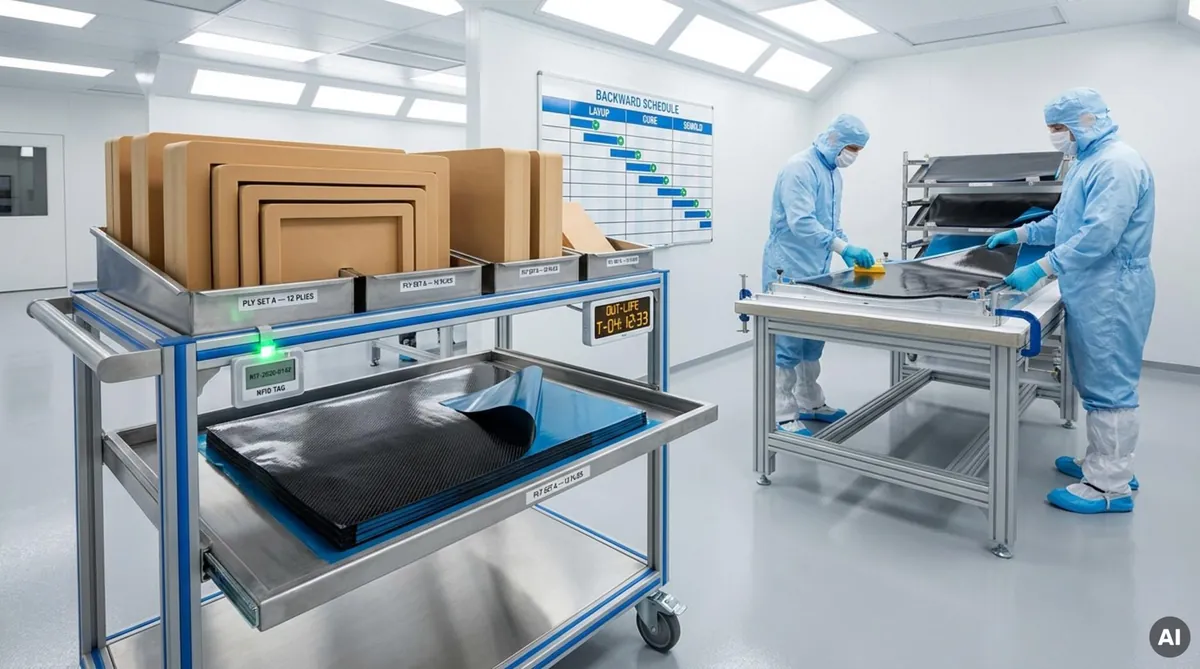
Backward scheduling provides an effective structure for managing high-mix composite production. Starting from the verified customer delivery date, the scheduling system works backward through each operational milestone, subtracting the required lead time for each phase to establish target release dates.
A standard backward manufacturing sequence follows these steps:
- Final packaging, crating, and shipping preparation.
- Quality release, CMM dimensional inspection, and NDT ultrasonic scan review.
- Surface finishing, primer application, and paint curing.
- Demolding, CNC perimeter trimming, and fastener hole drilling.
- Controlled cooling and initial visual part verification.
- Thermal curing inside an autoclave, press, or oven.
- Vacuum bagging, debulking, leak testing, and thermocouple attachment.
- Cleanroom lay-up, structural core integration, and adhesive film placement.
- Automated ply cutting, kitting, and sealed material thawing.
- Purchase order release for resins, reinforcements, and core materials based on procurement lead times.
7. How to Improve Lead Time Performance in Composite Production
Shortening lead times lowers working capital requirements, reduces work-in-progress costs, and improves delivery performance. However, reducing lead times in composite manufacturing cannot be achieved by simply increasing machine feeds or rushing manual lay-up.
Curing kinetics and resin properties require strict adherence to process specifications. Lead time reduction strategies must focus on eliminating upstream procurement friction and minimizing queue times between processing stages.
Qualify Multiple Suppliers for Long-Lead Materials
Relying on a single source for critical raw materials presents substantial operational risk. If a production program depends entirely on a single prepreg formulation or core supplier, production interruptions or testing rejections can halt composite assembly lines.
Manufacturers can approve alternative suppliers for standard dry fibers, structural foam cores, and processing consumables. Partnering with distributors that maintain regional stock-such as Chem-Craft providing short delivery times within five business days across Central and Eastern Europe-helps stabilize material supply lines and limits unexpected procurement delays.
Reduce Queue Time with Pre-Machined and Kitted Materials
In many facilities, structural sandwich cores spend extended periods waiting for machining, contouring, or heat stabilization. Machining raw foam sheets on the shop floor consumes valuable CNC capacity and increases cleanroom queue times.
Procuring ready-to-use, net-shape materials significantly compresses manufacturing lead time. Utilizing specialized external foam shape milling delivers core blocks pre-machined to tight tolerances (up to 0.1 mm or 0.05 mm), allowing parts to move directly into cleanroom lay-up without waiting for in-house routing. Pre-machined cores eliminate dust generation on the shop floor, reduce processing queues, and stabilize the critical path.
Minimize In-Process Staging and Workstation Bottlenecks
In composite manufacturing, parts often spend more time sitting in staging queues than undergoing active fabrication. A cured panel may require only forty-five minutes of CNC trimming but sit on a staging cart for several days waiting for machine availability.
Optimizing floor flow shortens lead times without altering validated manufacturing procedures. Visual management boards, clear floor routing, and managed batch sizes prevent WIP accumulation. Balancing lay-up output directly with thermal cure capacity prevents cleanrooms from producing work faster than autoclaves or ovens can process it, eliminating unnecessary out-life consumption.
8. Lead Time Metrics for Composite Production Control
Controlling lead time across composite manufacturing requires ongoing tracking of operational metrics. Without verified data on processing duration, tool turnover, and supply variations, scheduling adjustments lack technical foundation.
Modern manufacturing control relies on clear key performance indicators (KPIs) to identify delays before they affect customer delivery dates.
On-Time Delivery and Schedule Adherence
On-Time Delivery (OTD) remains the primary measure of customer satisfaction, tracking the percentage of deliveries completed on or before the agreed contract milestone. High-performance composite manufacturers consistently target an OTD rate above 98%.
Maintaining high OTD requires measuring schedule adherence at individual workstations. This metric confirms whether specific operations-such as cutting, lay-up, curing, or NDT-meet their daily production targets. If a cleanroom achieves only 80% schedule adherence due to bagging delays, downstream autoclaves will experience scheduling gaps within 24 to 48 hours. Measuring work centers independently isolates the root causes of process delays.
Manufacturing Lead Time and Order-to-Ship Time
Manufacturing Lead Time (MLT) calculates the total elapsed time from the release of raw materials to the completion of inspected, packaged parts. Tracking MLT across distinct product families reveals emerging process drift. A steady increase in MLT often points to uncalibrated tooling, equipment maintenance delays, or cleanroom queue accumulation.
Order-to-Ship Time captures the full span from initial purchase order receipt to final product dispatch. This metric incorporates contract review, tool design, material procurement, composite manufacturing, and quality sign-off. Tracking both metrics ensures that shop-floor efficiency gains are not undermined by delays in engineering approvals or administrative processing.
Composite facilities increasingly manage lead time using integrated digital execution tools. Radio Frequency Identification (RFID) systems attached to tool carriers, core kits, and material carts provide Manufacturing Execution Systems (MES) with real-time tracking data on work-in-progress locations and out-time usage. Cure simulation software also allows engineers to model thermal transfer within autoclaves and ovens, optimizing tool placement and heating cycles to safely reduce cycle duration. Combining digital workflow monitoring with disciplined material planning eliminates process variability and ensures the repeatable production of lightweight composite structures.