
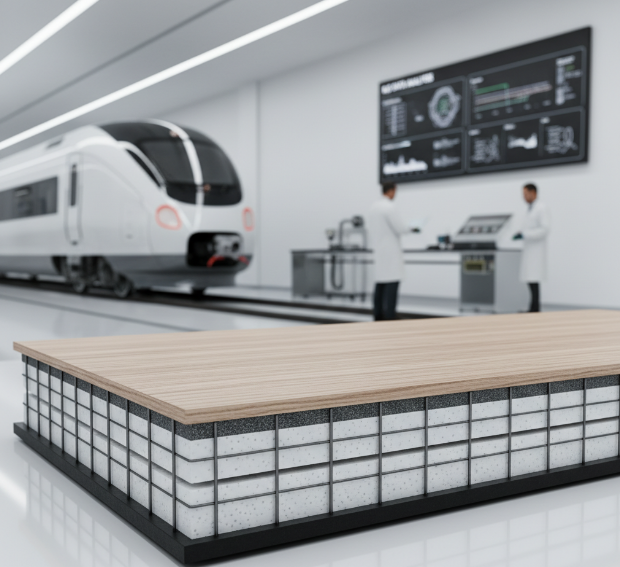
Rail transport occupies an unusual position in the materials conversation. Unlike aerospace, where every gram is tracked with near-obsessive precision, the rail sector has historically been more tolerant of mass. Steel and aluminium have dominated carriage construction for over a century, and for good reason – they are well understood, widely available, and backed by deep regulatory frameworks. But tolerance of mass is not the same as indifference to it, and the economics of modern rail are forcing a reassessment.
Lighter rolling stock means lower energy consumption per passenger-kilometre. It means reduced wear on track infrastructure, less stress on bogies and suspension components, and shorter braking distances. When multiplied across fleets of hundreds of vehicles running daily services for thirty years, even modest weight reductions in floor and ceiling panels translate into substantial operational savings.
The Case for Composite Sandwich Panels in Rail Interiors
Floor and ceiling panels are not glamorous components. They do not carry primary structural loads in the way that a car body shell does. What they do carry is a surprising number of performance obligations: they must resist foot traffic and point loads, attenuate noise and vibration, provide thermal insulation, meet fire safety requirements that vary by jurisdiction, and do all of this without adding unnecessary weight to the vehicle.
Traditional panel constructions rely on plywood, mineral wool, and sheet metal in various combinations. These stacks work, but they are heavy, labour-intensive to assemble, and often over-engineered because the individual material layers interact in ways that are difficult to optimise analytically.
Sandwich panels built with rigid foam cores offer a fundamentally different approach. A thin composite skin bonded to each face of a low-density core creates a structure with high flexural stiffness at a fraction of the mass. The physics is straightforward – moving material away from the neutral axis increases the second moment of area – but the practical benefits in rail applications go well beyond simple stiffness.
Advantages of foam-cored sandwich panels for rail floor and ceiling applications include:
- Mass reductions of 30 to 50 percent compared to conventional metal-and-plywood assemblies, depending on panel geometry and load requirements, which directly lowers traction energy demand and axle loads.
- Integrated thermal and acoustic insulation within the core layer, eliminating the need for separate mineral wool blankets and their associated installation labour and attachment hardware.
- Design flexibility to incorporate compound curves, integrated mounting features, and varying thickness zones within a single moulded panel, reducing part count and simplifying interior fit-out sequences.
The manufacturing efficiency point deserves emphasis. Rail vehicle interiors contain dozens of individual panel sections, each requiring cutting, fitting, and fastening. A composite sandwich panel can be moulded to near-net shape with embedded inserts and local reinforcements, which compresses assembly time on the production line – a factor that matters when manufacturers are under pressure to deliver vehicles faster.
Fire Safety: The Regulatory Gatekeeper
No material enters a passenger rail vehicle without passing through a fire safety gauntlet. In Europe, EN 45545 sets the standard, classifying materials by their contribution to fire load, smoke density, and toxicity of combustion gases. The requirements are tiered – vehicles operating in tunnels or underground face the most stringent hazard levels.
This is where many lightweight materials stumble. Organic foams burn. Some produce dense, toxic smoke. A core material that saves weight but fails fire testing is, from a procurement standpoint, worthless.
PMI foams occupy a more favourable position than most organic core materials in this regulatory landscape. Their combustion behaviour can be managed through careful selection of skin materials and the use of intumescent layers or fire-barrier plies. The closed-cell structure of PMI foam also limits flame spread within the core itself, because there is no continuous air path for fire to follow.
Key fire performance considerations for foam-cored rail panels include:
- Compliance pathways under EN 45545 hazard levels HL1 through HL3, achievable through system-level design that combines PMI cores with phenolic or modified epoxy skins and appropriate surface finishes.
- Low smoke density and reduced toxic gas emission compared to PVC-based foams and certain polyurethane formulations that have historically been used in rail interiors.
- Retention of mechanical integrity during the early stages of fire exposure, which contributes to the structural survival time of the panel assembly and supports safe evacuation timelines.
Fire certification is always a system-level exercise, not a material-level one. The core alone does not pass or fail – the complete panel build-up does. This means that R&D programmes must invest in full-scale fire testing of representative panel configurations, not just small-scale coupon tests. That investment, while significant, pays dividends when it unlocks access to a family of panel designs rather than a single part number.
Processing and Manufacturability
Rail is not aerospace. Production volumes are higher, cost targets are tighter per square metre of panel, and the workforce is accustomed to metalworking rather than composite lay-up. Any core material aiming at rail adoption must be compatible with manufacturing methods that do not demand aerospace-grade tooling or cleanroom environments.
Vacuum infusion and light RTM processes suit rail panel production well. They use single-sided tooling, moderate pressures, and room-temperature or low-temperature cure resins. PMI foam cores – particularly grades designed for infusion, such as those with ultra-fine cell structures that minimise resin absorption – perform reliably in these processes without the autoclave infrastructure that drives up capital costs.
Thermoformability adds another dimension. Ceiling panels in modern rail vehicles often follow curved roof profiles. A flat foam sheet that can be heated and pressed into a curved shape on a simple forming tool eliminates the need for CNC machining of complex 3D core geometries. The result is shorter lead times and lower tooling investment, both of which matter to rolling stock manufacturers competing on price and delivery schedule.
Lifecycle Cost and the Maintenance Argument
The purchase price of a composite sandwich panel is higher than that of a plywood-and-metal equivalent. This is not a controversial statement – it is the first objection that procurement departments raise, and it is not wrong on a unit-cost basis.
The counterargument lives in lifecycle economics. Composite panels resist corrosion, do not rot, and maintain dimensional stability over service lives that in rail typically span twenty-five to thirty-five years. Metal panels in floor applications suffer from moisture ingress around fastener holes, leading to corrosion pockets that require repair or replacement during mid-life overhauls. Plywood delaminates. Mineral wool insulation settles and compresses, losing thermal and acoustic performance.
A foam-cored composite panel, properly designed and manufactured, largely avoids these degradation mechanisms. The closed cells do not absorb water. The composite skins resist chemical attack from cleaning agents and de-icing fluids. And because the panel is a bonded monolithic structure rather than a mechanically fastened assembly, there are fewer joints and interfaces where degradation initiates.
When R&D teams model total cost of ownership across a thirty-year vehicle life – including scheduled overhauls, unscheduled repairs, energy savings from mass reduction, and residual value at end of life – the composite panel frequently wins. The difficulty is that procurement decisions are often made on capital cost alone, which means the R&D case must be presented with rigour and supported by fleet-level data. That data is accumulating, and the trend line favours foam-cored sandwich construction in rail by a widening margin.