
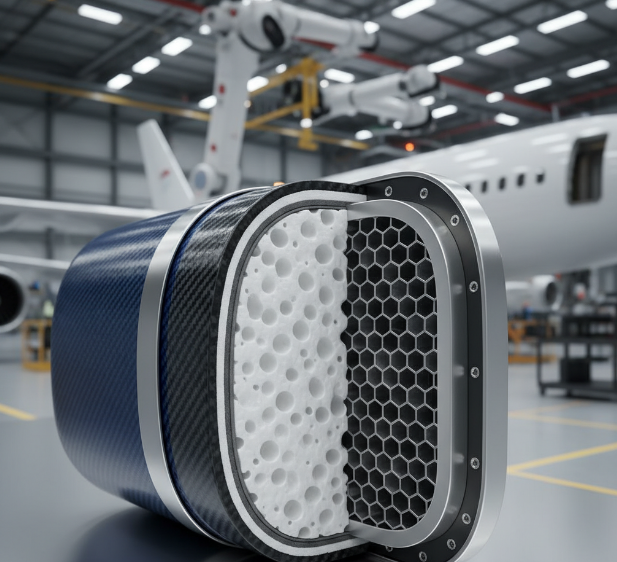
The aerospace industry has never been comfortable with compromise. Every gram added to an airframe eats into fuel economy, payload capacity, and operational range – yet every gram removed must not come at the cost of structural integrity. For decades, engineers relied on aluminium honeycomb cores and balsa wood to fill the gap between composite skins. Those materials served their purpose. They also came with limitations that modern aircraft programmes can no longer afford to accept.
Polymethacrylimide (PMI) rigid foams have changed the calculus. Closed-cell PMI foam cores now sit at the heart of next-generation sandwich structures in both commercial and military aviation, replacing legacy materials that once seemed irreplaceable. The shift did not happen overnight, but the reasons behind it are worth examining in detail.
Why Weight Reduction Alone Is Not Enough
Strip an aircraft down to its engineering essentials and you find a contradiction. Lighter structures save fuel. Lighter structures also flex more, fatigue faster, and tolerate less abuse during manufacturing and service. The real engineering challenge is not removing weight – it is removing weight while preserving or improving stiffness, impact tolerance, and long-term durability.
Traditional honeycomb cores are light, certainly, but they absorb moisture through open cells over time. That moisture adds parasitic weight and degrades bond lines. Balsa, while natural and reasonably stiff, varies in density from sheet to sheet and struggles at elevated processing temperatures.
PMI foam cores eliminate several of these problems simultaneously. Their closed-cell architecture resists moisture ingress. Their mechanical properties remain consistent across production batches. And their compressive creep behaviour – the tendency to deform permanently under sustained load at temperature – is uniquely predictable, which matters enormously when autoclave cure cycles push components to 180°C for hours at a time.
Key mechanical advantages of PMI core foams in airframe structures include:
- Compressive and shear strength values that scale reliably with density, giving engineers precise control over performance-to-weight trade-offs in stringer-stiffened panels, control surfaces, and radome assemblies.
- Thermal stability at operating temperatures up to 200°C, which allows co-curing with high-performance resin systems – including bismaleimide (BMI) – without core collapse or dimensional loss.
- Consistent cell morphology that permits clean machining of complex contoured shapes, a critical factor for aerodynamic fairings and engine nacelle components where surface accuracy directly affects drag.
Processing Compatibility: The Hidden Differentiator
Material properties alone do not win specification battles in aerospace. Processability does. A foam core that delivers perfect numbers on a datasheet but cracks under autoclave pressure or absorbs excessive resin during infusion will never make it past the qualification stage.
This is where the range of available PMI grades becomes significant. ROHACELL® IG-F is one of the most widely adopted grades for prepreg lay-up processes. Its cell structure tolerates the pressures and temperatures typical of autoclave curing – up to 0.3 MPa and 130°C – and its surface characteristics keep resin uptake to a minimum. Less resin absorbed into the core means less added weight and a more predictable laminate thickness, both of which matter for parts that must meet tight dimensional tolerances.
For programmes that demand even higher thermal and pressure resistance, ROHACELL® XT handles curing temperatures reaching 180°C and pressures up to 0.45 MPa. After heat treatment, the XT-HT variant pushes those limits further – 190°C and 0.7 MPa – making it compatible with BMI resin systems that many military platforms require. Pressureless post-cure processes at temperatures as high as 240°C become feasible as well, opening doors that honeycomb and balsa simply cannot walk through.
Processing methods supported by current PMI foam grades span a broad range:
- Autoclave prepreg curing, the dominant process for primary and secondary aerostructures where fibre volume fraction and void content must be tightly controlled.
- Vacuum infusion and resin transfer moulding (RTM), increasingly used for complex geometries and larger panel sections where out-of-autoclave manufacturing reduces capital expenditure.
- Thermoforming of flat foam sheets into compound-curved shapes, which eliminates the need for multi-piece core assemblies and the associated bond-line weight and risk.
The ability to thermoform a rigid foam core is not a trivial advantage. It reduces part count, shortens assembly time, and removes potential failure modes at core splice joints – all of which contribute to lower recurring production costs.
Real-World Applications in Commercial and Military Aviation
The practical deployment of PMI foams in aerospace extends well beyond laboratory specimens. ROHACELL® WF was designed specifically for aerospace use and satisfies MIL and CMS specifications alongside manufacturer material requirements. Its adoption in stringer structures within pressure bulkheads demonstrates that the material performs not only under aerodynamic loads but also under the cyclic pressurisation that commercial fuselages endure tens of thousands of times over their service life.
Helicopter programmes rely on PMI cores in particularly demanding locations. Main and tail rotor blades experience extreme dynamic loading – a combination of centrifugal force, aerodynamic bending, and high-frequency vibration. Fuselage panels and rotor blade skins built with PMI sandwich construction have demonstrated the fatigue life required to meet certification standards that are, by any measure, unforgiving.
Military applications add another layer of complexity. Radar-transparent structures – radomes, antenna housings, and electronic warfare enclosures – need core materials with extremely low dielectric constants. Standard structural foams often fall short here because their cell structure scatters or absorbs electromagnetic energy in ways that degrade sensor performance. ROHACELL® HF addresses this gap with a particularly fine cell structure optimised for high-frequency transmission, making it a go-to material for antenna and radome applications where signal integrity is non-negotiable.
Where the Industry Goes From Here
Production rates in commercial aviation are climbing. Single-aisle programmes are targeting outputs that would have seemed unrealistic a decade ago. That volume pressure favours materials and processes that are repeatable, automatable, and forgiving of minor process variations. PMI foams score well on all three counts.
Emerging trends also point toward greater use of out-of-autoclave processing, driven by the capital and operational cost of large autoclaves. Foam cores that perform reliably under vacuum-only consolidation – without the safety net of external pressure – will capture increasing market share. Grades with ultra-fine cell structures and minimal resin absorption are positioned to benefit here, because every gram of excess resin that a foam core does not absorb is a gram that does not need to be justified on a weight budget.
Sustainability considerations are beginning to influence material selection as well. The total lifecycle energy cost of a structural material – from raw feedstock through manufacturing, service, and eventual disposal – is entering the conversation alongside traditional metrics like specific stiffness and cost per kilogram. Closed-cell foams that reduce overall laminate weight contribute to fuel savings over an aircraft’s operational life measured in decades and tens of thousands of flight cycles.
The old framing of lightweight versus strength was always a false binary. Modern PMI core foams have made it an obsolete one. The real question facing aerospace engineers today is not whether to use structural foam cores, but which grade, density, and processing route will extract the maximum performance from a design that must be lighter, stronger, and more cost-effective than anything that came before it.