
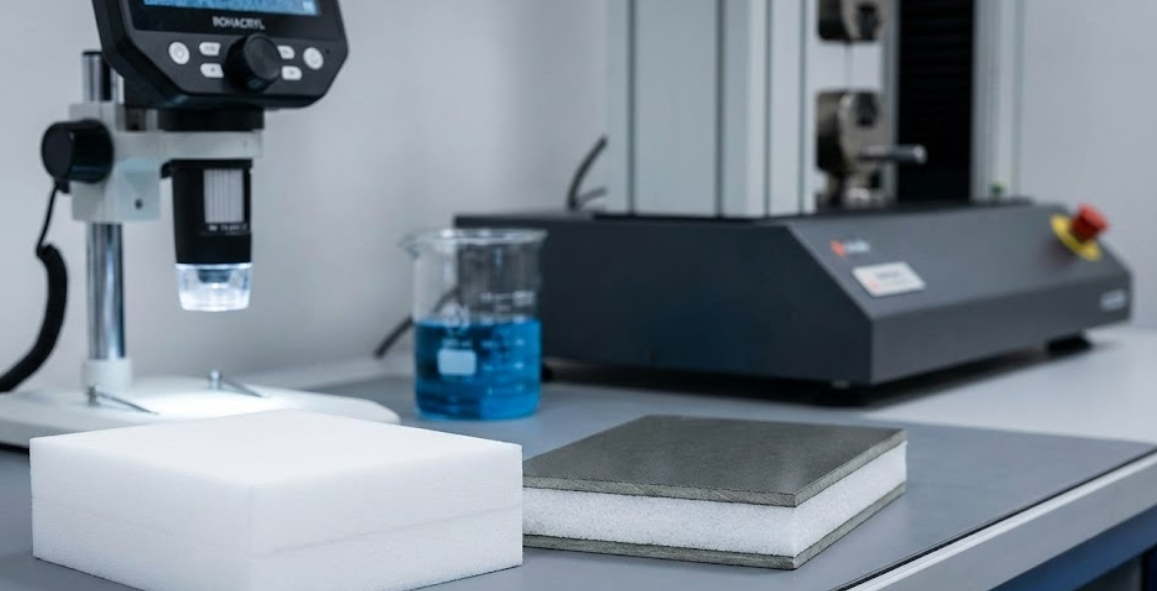
Structural foam technology doesn’t stand still. While incremental improvements to established materials continue—slightly better properties here, modest cost reductions there—genuine innovation that changes what’s possible in composite design happens rarely. ROHACRYL® represents one of those rare moments. Developed by Evonik and distributed through partners like CHEM-CRAFT, this acrylic-based foam chemistry introduces capabilities that didn’t previously exist in a single material system, opening applications that engineers couldn’t practically address before.
Understanding what makes ROHACRYL® genuinely innovative—rather than simply another entry in a crowded foam market—requires examining both the material science that enables its properties and the practical implications for manufacturers and designers working to build better, lighter, more sustainable composite structures.
The Acrylic Chemistry Foundation
Most rigid structural foams fall into familiar chemical families: PVC, PET, polyurethane, or the PMI chemistry that underlies premium foams like ROHACELL®. Each chemistry brings inherent characteristics that determine what the resulting foam can and cannot do. ROHACRYL® emerges from a fundamentally new acrylic chemistry that Evonik developed specifically to address limitations in existing foam options.
This isn’t reformulation or optimization of existing approaches. The acrylic polymer system underlying ROHACRYL® was engineered from molecular principles to deliver a specific combination of properties that market analysis identified as underserved: thermal stability sufficient for industrial processing, mechanical properties competitive with premium foams, recyclability aligned with emerging sustainability requirements, and economics viable for high-volume applications.
The chemistry enables thermal processing up to 120°C—a threshold that sounds modest compared to ROHACELL® XT’s 180°C capability, but represents a significant step beyond what PVC foams (typically limited to 60-80°C) can tolerate. This 120°C thermal stability positions ROHACRYL® in a practical sweet spot: capable enough for the majority of industrial composite processes, without the cost premium associated with aerospace-grade PMI materials.
Cell Structure Engineering
Foam properties depend critically on cell morphology—the size, shape, and wall structure of the individual bubbles that constitute the foam matrix. ROHACRYL® incorporates cell structure innovations that distinguish it from both commodity foams and competing premium materials.
The cells are notably small and remarkably uniform. This fine, homogeneous cell structure delivers multiple performance benefits:
- Surface smoothness that translates to better cosmetic quality in finished composite parts
- Consistent mechanical properties throughout the foam volume, reducing variability in component performance
- Predictable thermoforming behavior that enables complex geometries without localized defects
- Minimal resin absorption during infusion and RTM processing
That last point—resin uptake—deserves particular attention because it illustrates how cell structure engineering translates to system-level value. When ROHACRYL® achieves resin uptake around 250 g/m², that performance isn’t accidental. It results from deliberate optimization of cell size and closed-cell integrity to minimize the surface area and pathways through which resin can penetrate.
Every gram of resin that doesn’t absorb into the core is weight saved and cost avoided. At production scale, those savings compound into significant competitive advantage.
The Recyclability Breakthrough
Sustainability has evolved from marketing talking point to genuine engineering constraint. Regulations increasingly mandate end-of-life recyclability. Customers specify recycled content requirements. Lifecycle assessments influence material selection in ways they didn’t a decade ago. Traditional thermoset-based foams often struggle against these sustainability criteria—once crosslinked, they cannot be reprocessed through conventional recycling streams.
ROHACRYL®’s acrylic chemistry enables genuine recyclability through established pathways. The material can be processed at end-of-life rather than landfilled, aligning with circular economy principles that are reshaping material specification across industries. This isn’t theoretical recyclability that requires specialized facilities; it’s practical recyclability compatible with existing infrastructure.
For industries facing regulatory pressure around sustainability—automotive manufacturers subject to end-of-life vehicle directives, wind energy companies addressing blade disposal challenges, consumer goods companies responding to customer expectations—ROHACRYL®’s recyclability represents differentiation that specifications sheets alone can’t capture.
Mechanical Performance Innovation
Innovation in foam chemistry would mean little if ROHACRYL® couldn’t deliver the mechanical properties that structural applications demand. The material performs at levels that challenge assumptions about what’s achievable outside premium PMI formulations.
Shear modulus—a critical property for sandwich core materials—reaches 47 MPa in ROHACRYL® SW grades. This stiffness provides the resistance to shear deformation that sandwich panels need to function as efficient structural elements. The high mechanical properties including 47 MPa shear modulus position ROHACRYL® for applications where PVC and PET foams would require either higher densities or acceptance of reduced structural efficiency.
Compressive strength similarly exceeds what lower-cost alternatives deliver. The foam maintains dimensional stability under the loads that composite processing imposes, avoiding the densification and print-through that can compromise surface quality and dimensional accuracy in finished parts.
The property balance ROHACRYL® achieves—thermal stability, mechanical performance, recyclability, and economics—didn’t exist in a single material before. Engineers previously chose between sustainability and performance, or between thermal capability and cost. ROHACRYL® collapses those trade-offs into a material that delivers across previously competing requirements.
Processing Advantages
Materials prove their value in manufacturing, not just in laboratory testing. ROHACRYL®’s processing characteristics accommodate the methods that dominate modern composite production without requiring specialized equipment or procedures.
The foam works effectively with:
- Vacuum infusion, where its low resin uptake preserves weight efficiency
- RTM processes, where dimensional stability under injection pressure maintains tolerances
- Hand layup for prototype and low-volume applications
- CNC machining using standard equipment and tooling
This versatility across common processing methods eliminates the adoption barriers that novel materials sometimes present. Manufacturers can integrate ROHACRYL® into existing workflows without capital investment in new equipment or retraining of production staff. The material slots into established processes, which dramatically accelerates the path from evaluation to production implementation.
Thermoformability adds geometric flexibility. ROHACRYL® can be heated and formed into complex curves without the cell damage that some foams exhibit during forming operations. For applications requiring aerodynamic fairings, automotive body panels, or other compound-curved geometries, this formability reduces both tooling costs and material waste compared to machining from flat stock.
Economic Innovation
Perhaps ROHACRYL®’s most significant innovation isn’t technical at all—it’s economic. By delivering premium-tier properties at price points competitive with commodity foams, ROHACRYL® makes high-performance sandwich construction viable for applications where cost sensitivity previously precluded advanced materials.
Consider wind turbine blade manufacturing, where competitive pressure demands continuous cost reduction while technical requirements demand lightweight, fatigue-resistant construction. Traditional material choices forced blade manufacturers to either accept the limitations of commodity foams or absorb the cost premium of PMI materials. ROHACRYL® offers a third path that combines performance with production economics.
The same dynamic applies across high-volume industries: automotive structural components, marine vessels, sports equipment, industrial applications. In each sector, ROHACRYL® enables designs that weren’t economically practical before, expanding the addressable market for advanced sandwich composite construction.
The Broader Innovation Context
ROHACRYL® doesn’t exist in isolation. It represents one element of Evonik’s broader foam technology portfolio, complementing rather than replacing the ROHACELL® PMI grades that address the most demanding aerospace and high-performance applications. The availability of both material families from a single technology source allows engineers to right-size material selection to application requirements—specifying ROHACELL® where its premium capabilities are justified, ROHACRYL® where its balance of properties and economics fits better.
This portfolio approach reflects maturation in the structural foam market. Rather than one-size-fits-all solutions, engineers now have access to tailored options that optimize different trade-off points. The innovation lies not just in ROHACRYL®’s individual properties, but in how its availability expands the design space for composite engineers working across industries and applications.
Looking Forward
Material innovation tends to enable application innovation. When new material capabilities become available, designers find uses that weren’t previously practical. ROHACRYL®’s combination of thermal performance, mechanical properties, recyclability, and economics will likely spawn applications that are difficult to anticipate today.
What seems clear is that the assumptions constraining composite material selection have shifted. The trade-offs that engineers accepted as inevitable—performance versus cost, capability versus sustainability, thermal stability versus recyclability—no longer hold in their traditional forms. ROHACRYL® demonstrates that foam technology continues advancing in ways that matter practically, opening possibilities for lighter, more sustainable, more economically viable composite structures across the industries that CHEM-CRAFT serves throughout Europe and beyond.