
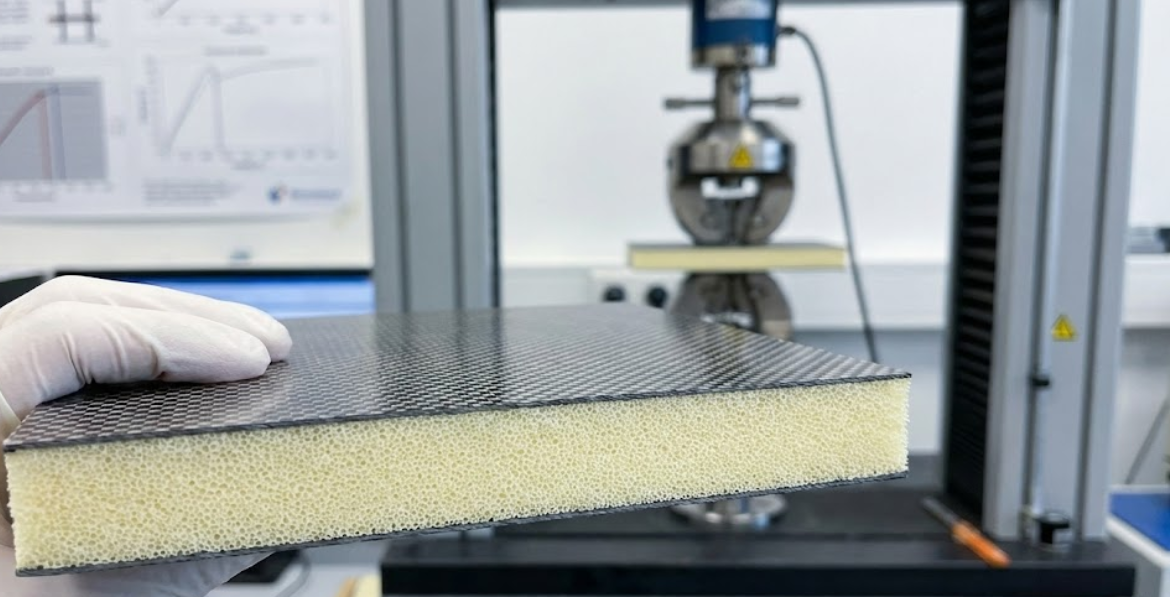
When engineers discuss structural foam cores, the conversation inevitably circles back to a fundamental tension: the desire for low weight pulling against the demand for high mechanical performance. Most foam materials force designers into uncomfortable compromises along this continuum. ROHACELL® polymethacrylimide foams from Evonik occupy unusual territory in this landscape, delivering mechanical properties that seem to defy the typical weight-strength trade-offs that constrain material selection in demanding applications.
Understanding what makes ROHACELL® mechanically exceptional requires moving beyond marketing claims into the underlying material science. The PMI chemistry, the foam morphology, and the thermal processing history combine to create a material system whose strength-to-weight ratio stands above other structural foams. This article examines those mechanical characteristics in detail, providing the technical foundation that engineers need to evaluate ROHACELL® for their specific applications.
The Density-Property Relationship
ROHACELL® is manufactured across a range of densities, from 31 kg/m³ to 200 kg/m³ and beyond in specialty grades. This density range isn’t merely about offering different price points—it represents deliberate engineering of the foam microstructure to optimize different property combinations. Lower-density grades maximize weight savings where loads are moderate; higher-density grades deliver the mechanical capability needed for structurally demanding applications.
What distinguishes ROHACELL® from competing foam systems is how gracefully its properties scale with density. Many foams exhibit steep property degradation as density decreases, forcing designers to over-specify density to achieve adequate mechanical margins. ROHACELL® maintains excellent mechanical properties even at very low densities, extending the useful design envelope further into lightweight territory than alternatives typically allow.
The practical implication is significant. When a ROHACELL® 51 IG-F grade (approximately 52 kg/m³) delivers properties that competing foams only achieve at 75 or 80 kg/m³, every sandwich panel specified with that ROHACELL® grade carries correspondingly less weight. Across large structures—aircraft fuselage panels, wind turbine blades, marine vessels—those per-square-meter savings accumulate into performance advantages that compound over the product’s service life.
Compressive Behavior and Creep Resistance
Compressive strength represents a critical property for foam cores, particularly in sandwich construction where the core resists loads transferred through the face sheets. ROHACELL® exhibits compressive strength values that position it at the upper end of rigid foam performance, but raw compressive strength tells only part of the story. The foam’s behavior under sustained loading—its creep resistance—often proves more decisive in engineering applications.
ROHACELL® demonstrates unique compressive creep behavior for processing conditions up to 180°C and 0.7 MPa. This characteristic matters enormously during composite manufacturing, where cores experience elevated temperatures and pressures during cure cycles. Materials with poor creep resistance can densify, deform, or develop print-through during processing, creating dimensional problems and cosmetic defects in the finished part.
The ability to maintain dimensional stability under autoclave conditions—the 180°C and 0.7 MPa envelope—places ROHACELL® in select company among structural foams. Grade selection allows engineers to match creep resistance to specific processing requirements:
- ROHACELL® IG-F grades suit processing at temperatures up to 130°C and pressures up to 0.3 MPa, accommodating most prepreg applications
- ROHACELL® XT grades handle the most demanding conditions: curing temperatures to 180°C and pressures to 0.45 MPa, extendable to 190°C and 0.7 MPa after heat treatment
- ROHACELL® RIMA grades offer 0.7 MPa pressure capability at 130°C, with heat-treated variants reaching 180°C at the same pressure
- ROHACELL® WF provides aerospace-qualified properties with processing conditions balanced for typical aircraft component manufacturing
This grade structure allows engineers to select precisely the capability level their application requires without paying for unused processing headroom. The cost optimization extends beyond material pricing: specifying the right grade for a given process avoids both the expense of over-specification and the risks of under-specification.
Dynamic Strength and Fatigue Performance
Static mechanical properties establish baseline capability, but many high-value ROHACELL® applications involve dynamic loading where fatigue behavior determines service life. Helicopter rotor blades, wind turbine components, and sporting equipment all experience cyclic loading measured in millions of load reversals. Materials that look adequate in static testing may fail prematurely when subjected to real-world fatigue environments.
ROHACELL® exhibits excellent dynamic strength characteristics that translate static capability into fatigue performance. The PMI polymer matrix maintains its integrity under cyclic loading without the microcracking and progressive degradation that compromises some competing foams. This fatigue resistance allows designers to specify ROHACELL® with confidence in applications where the consequences of in-service failure are severe.
The dynamic strength advantage connects directly to the foam’s closed-cell morphology. Each cell in the foam structure acts as a discrete load-bearing element, and the uniformity of cell size and wall thickness ensures consistent load distribution throughout the material. Stress concentrations that could initiate fatigue damage are minimized by the homogeneous microstructure that Evonik’s manufacturing process achieves.
Temperature-Dependent Properties
Foam mechanical properties typically degrade as temperature increases, limiting applications where elevated service temperatures are expected. ROHACELL® breaks from this pattern by maintaining mechanical capability across a temperature range that extends far beyond most rigid foams. The high temperature resistance extending to 200°C for certain grades opens applications where ambient operating conditions would rule out conventional foam cores.
This thermal stability isn’t merely about surviving elevated temperatures—it’s about maintaining functional mechanical properties at those temperatures. ROHACELL® grades retain meaningful percentages of their room-temperature strength and stiffness at temperatures where competing materials have already softened to the point of structural irrelevance. The distinction matters for applications including:
- Aerospace components exposed to aerodynamic heating or proximity to engines and hot section equipment
- Automotive structural elements near powertrain components or in under-hood environments
- Industrial applications involving process heat or elevated ambient operating conditions
- Electronics housings where thermal management requirements create localized hot spots
The temperature performance also influences processing flexibility. When a foam can withstand higher cure temperatures, manufacturers can use faster-curing resin systems and shorter cycle times. The productivity benefit compounds with production volume, making ROHACELL®’s thermal stability an economic advantage as well as a technical one.
Cell Structure and Its Mechanical Implications
ROHACELL®’s mechanical properties emerge from its carefully controlled foam morphology. The closed-cell structure—with individual cells isolated from their neighbors by continuous polymer walls—creates a system where mechanical loads are carried efficiently through the cell walls and distributed across the foam volume. Open-cell foams, by contrast, allow stress concentrations and provide less efficient load paths.
Evonik has developed the capability to tailor cell sizes for specific processing methods across the ROHACELL® grade range. Grades intended for infusion processes benefit from fine cell structures that minimize resin absorption into the core. Grades optimized for machining can accommodate slightly larger cells that improve cutting behavior without sacrificing mechanical properties. This tailoring isn’t about compromising performance—it’s about optimizing the complete system of core material and processing method.
The RIMA grades exemplify this approach. Their cell structure has been specifically designed to achieve resin uptake levels around 50 g/m², dramatically lower than standard grades. For weight-critical applications where every gram of parasitic resin weight matters, RIMA’s engineered cell structure delivers measurable system-level benefits that justify its specification despite the premium involved.
Practical Selection Considerations
The breadth of the ROHACELL® product line can overwhelm engineers approaching PMI foams for the first time. The grade designations—IG-F, HF, WF, RIMA, XT, SL—represent distinct property combinations optimized for different application requirements. Effective material selection requires matching the grade’s characteristics to the application’s specific demands:
- IG-F grades represent the versatile workhorse choice for general-purpose applications, balancing properties and cost effectively
- HF grades target applications requiring minimal dielectric interference, particularly antenna and electronic equipment
- WF grades carry aerospace qualifications that simplify certification for aircraft applications
- XT grades address the most demanding thermal and pressure conditions, justifying their premium for applications that genuinely require such capability
The density suffix numbers (31, 51, 71, 110, 200) indicate approximate density in kg/m³, providing immediate guidance on the weight-strength trade-off each variant offers. Higher density grades deliver greater absolute mechanical properties; lower density grades maximize weight efficiency where loads permit.
The Mechanical Performance Standard
ROHACELL® has established itself as the benchmark against which other structural foams are measured. Its combination of strength-to-weight performance, thermal stability, creep resistance, and fatigue capability defines the upper boundary of what rigid foam cores can achieve. Competing materials may approach ROHACELL® on individual properties, but few can match the complete package of characteristics that demanding applications require.
For engineers specifying foam cores in structurally demanding, thermally challenging, or weight-critical applications, understanding ROHACELL®’s mechanical properties provides the foundation for informed material selection. The investment in premium PMI foam pays returns through superior component performance, extended service life, and the design freedom that comes from working with materials that refuse the usual compromises.