For decades, the composite industry relied heavily on Polyvinyl Chloride (PVC) foams as the standard core material for sandwich constructions. From wind turbine blades to boat hulls, PVC was the go-to solution due to its relatively low cost and decent mechanical properties. However, as the demand for higher performance, faster production cycles, and more sustainable materials has grown, the limitations of PVC have become increasingly apparent. Enter ROHACRYL®, a revolutionary acrylic-based foam produced by Evonik. This material represents a significant leap forward in chemistry and engineering, offering a very small and closed cell structure that addresses many of the historical weaknesses of PVC.
This article provides a comprehensive performance analysis of ROHACRYL® compared to traditional PVC foams, focusing on thermal stability, resin efficiency, and mechanical integrity. As the official Evonik distributor and partner, CHEM-CRAFT is at the forefront of this industrial shift, helping manufacturers transition to these advanced acrylic cores to improve their bottom line and product quality.
The Chemistry of Success: Acrylic vs. Vinyl
The fundamental difference between these two materials lies in their chemical composition. PVC foams are produced using a complex blend of polymers and blowing agents, which often include CFCs or other environmentally harmful substances in older formulations. ROHACRYL®, however, is based on a new type of acrylic chemistry that is free of CFCs and designed for high-performance industrial environments.
One of the most immediate benefits of this new chemistry is thermal stability. PVC foams generally have a glass transition temperature (Tg) that limits their processing to around 80°C. If subjected to higher temperatures, PVC can lose its dimensional stability, outgas, or even collapse. ROHACRYL® is designed for high thermal processing up to 120°C, making it compatible with a much wider range of resin systems and curing cycles. This allows manufacturers to move away from slow, room-temperature cures toward faster, heated processes.
Key Performance Advantages of ROHACRYL® Over PVC:
- Thermal Resilience: While PVC struggles above 80°C, ROHACRYL® maintains its structural integrity at 120°C, allowing for increased production speed through faster resin curing.
- Environmental Impact: ROHACRYL® is a Recyclable structural foam for high-volume applications, offering a more sustainable lifecycle than many traditional cross-linked PVC foams.
- Cell Uniformity: The manufacturing process for ROHACRYL® results in a more homogeneous cell structure, which eliminates the “soft spots” or large voids sometimes found in lower-quality PVC sheets.
Resin Uptake and Economic Efficiency
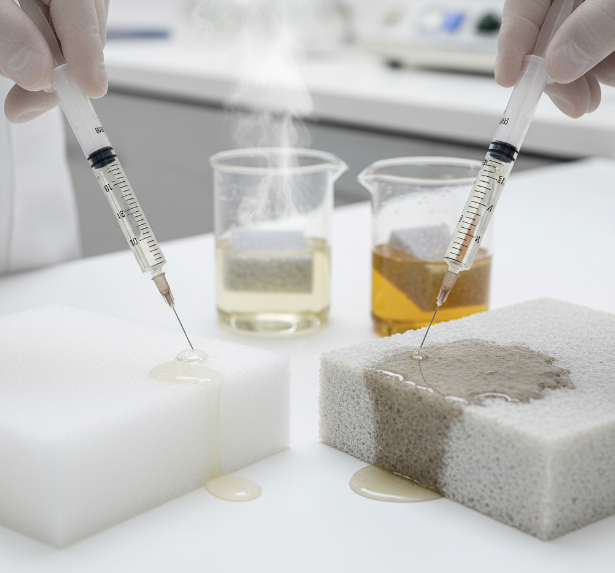
In the world of sandwich composites, weight is money. The goal is to use as much core as possible and as little resin as necessary to bond the skins. This is where the cell size of the foam becomes critical. Traditional PVC foams often have relatively large or “torn” surface cells that act as small cups, soaking up resin during the infusion or hand lay-up process. This absorbed resin adds significant weight to the final part without contributing to its strength.
ROHACRYL™ SW is ideal for lightweight sandwich construction because its fine, closed-cell structure keeps resin absorption at the surface to a strict minimum. In fact, the very low resin uptake of ROHACRYL®—which can be as low as 250 g/m²—represents a massive saving compared to many PVC cores. When you multiply these savings across a high-volume production line, such as automotive body panels or sports equipment, the reduction in total raw material costs is substantial.
Mechanical Integrity and Shear Strength
A core material’s primary job is to resist shear forces and prevent the sandwich skins from buckling. PVC foams are known for being somewhat brittle, especially as they age or are exposed to UV radiation. Acrylic foams like ROHACRYL® exhibit higher toughness and a better shear modulus for their weight class. With a shear modulus reaching up to 47 MPa, ROHACRYL® provides the stiffness required for dynamic applications like wind energy blades or high-speed marine vessels.
Furthermore, ROHACRYL® offers a superior strength to weight ratio that allows engineers to either reduce the thickness of the core or move to a lower density without sacrificing the structural safety of the part. This mechanical efficiency is why ROHACRYL® is increasingly favored in the “sports and leisure” segment, where products like skis, snowboards, and surfboards require a material that can withstand high-impact loads without failing.
Comparative Industry Applications:
- Marine and Sub-sea: While PVC has long been used in boat building, ROHACRYL® provides better resistance to long-term fatigue and thermal fluctuations.
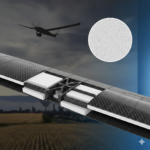
- Wind Energy: For the shear webs and shells of turbine blades, the thermal stability of ROHACRYL® allows for more aggressive infusion cycles and higher quality control.
- Automotive: The ability to be easily thermoformed and machined using standard CNC equipment makes ROHACRYL® a superior choice for lightweight vehicle components.
Processing and Technical Support from CHEM-CRAFT
One of the hurdles manufacturers face when switching from PVC to a high-performance acrylic is the change in processing parameters. Because ROHACRYL® behaves differently under heat and pressure, it requires a specialized approach. This is where the expertise of CHEM-CRAFT becomes invaluable. We are not just suppliers; we are a team of composite engineers specialized in methods such as hand lay-up, RTM, infusion, and autoclave.
We understand that every production line is different. Whether you are currently using vacuum infusion at ambient temperatures or a high-pressure RTM process, our team can provide the consulting advice needed to integrate ROHACRYL® seamlessly. By switching from PVC, you are not just changing a material; you are upgrading your entire manufacturing capability. The precision-machined components possible with ROHACRYL® allow for tighter tolerances and more complex designs that PVC simply cannot achieve without significant risk of failure.
The Future of High-Volume Composites
As the industry moves toward “Industry 4.0” and automated manufacturing, the reliability of the core material becomes paramount. PVC foams, with their inconsistent cell structures and low thermal limits, are often the “weak link” in automated production. The stability and predictability of ROHACRYL® make it the perfect candidate for high-volume, automated infusion and molding processes.
By partnering with CHEM-CRAFT, manufacturers in Northern Europe, Eastern Europe, and the BeNeLux countries gain access to a reliable supply of these high-performance foams with short lead times and low minimum order values. This accessibility is crucial for SMEs and large-scale manufacturers alike, ensuring that they can innovate and compete on a global scale.
Conclusion
The analysis is clear: while PVC foams served the industry well during the early years of composite development, the future belongs to advanced chemistries like those found in ROHACRYL®. With its high thermal performance and stability, lower resin absorption, and superior mechanical properties, ROHACRYL® offers a clear path toward lighter, stronger, and more cost-effective products.
Transitioning from PVC to ROHACRYL® is more than a material swap—it is a commitment to quality and efficiency. By leveraging the technical support of CHEM-CRAFT and the innovation of Evonik, manufacturers can overcome the limitations of the past and build the high-performance structures of the future. Whether you are building the next generation of wind turbines or a world-class racing yacht, the performance analysis proves that ROHACRYL® is the superior choice for modern composite engineering.