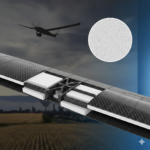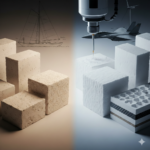
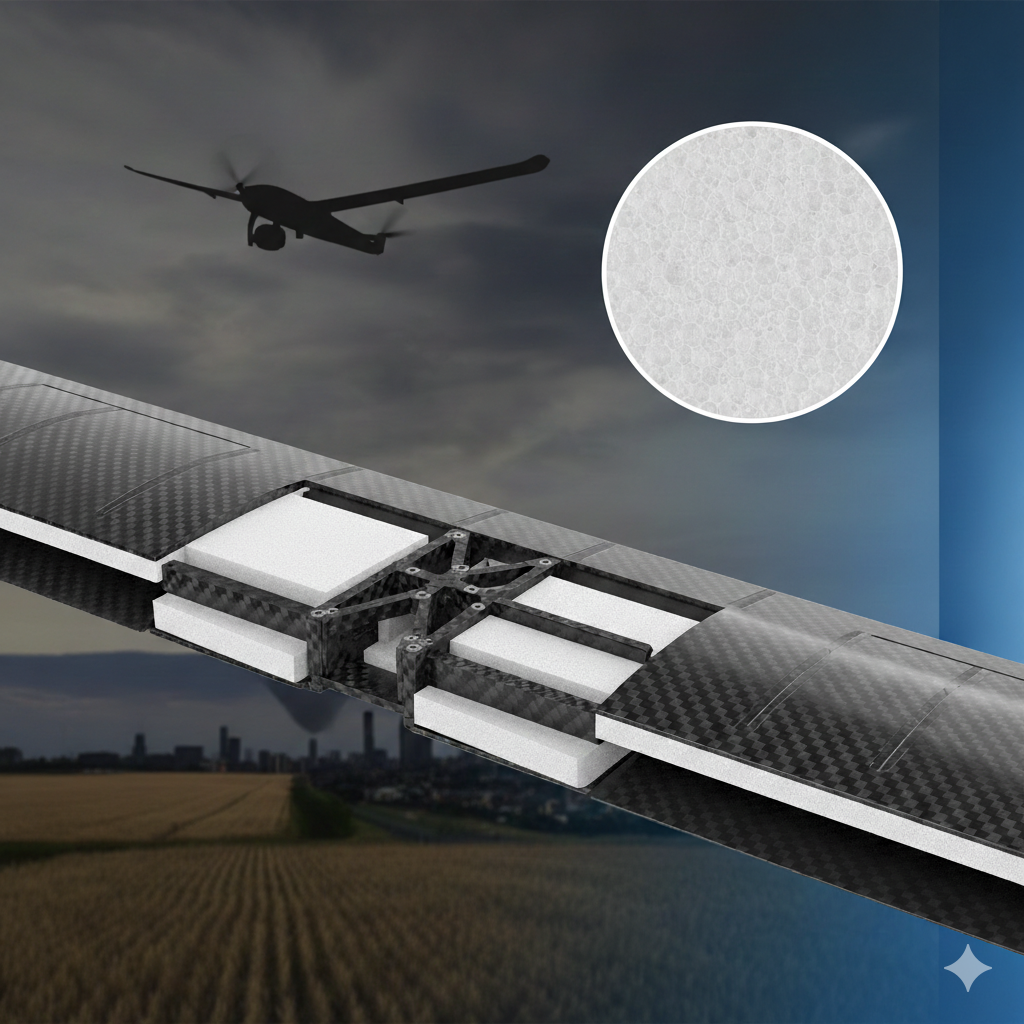
PMI foam cores are finding a natural home in drone manufacturing — where thin sandwich panels, dual-usage capability, and zero tolerance for excess weight define the engineering brief.
Why Core Material Choices Matter More in Drones Than Anywhere Else
In manned aircraft, the weight penalty of a suboptimal core material can be absorbed across a large airframe. In a drone weighing 5 to 25 kg, that same penalty hits range and endurance directly. Every unnecessary gram of resin soaked into a foam core is a gram that the battery has to carry through the entire mission profile. Over a multi-hour sortie, the cumulative effect on flight time is measurable and significant.
This is what makes foam core selection in UAVs a different conversation than in traditional aerospace. The panels are thinner, the foam layers are often just 1 to 3 mm thick, and the margins are razor-tight. A core material that performs well at 10 mm thickness may behave completely differently at 1.5 mm — and that distinction matters enormously.
The Thin-Section Problem: Resin Infiltration at Low Thicknesses
When building a sandwich panel, the basic principle is straightforward: place a lightweight core between two face sheets of carbon or glass fibre, and the resulting structure gains dramatically higher bending stiffness without a proportional increase in weight. The foam acts as a spacer, increasing the second moment of area (cross-sectional inertia), which is the geometric property that governs how resistant a panel is to bending.
The catch is that this only works if the core stays light. In practice, conventional foams like PVC and PET suffer from a well-known issue — resin infiltration during lamination. When the composite is laid up and cured, liquid resin migrates into the open or semi-open cells at the foam surface. At standard thicknesses of 5 mm or more, this surface absorption is a manageable fraction of total core volume. But at thicknesses below 2 mm, it becomes a different story entirely.
At 1–2 mm, PVC and PET cores can become fully saturated with resin. The foam essentially turns into a dense resin layer, eliminating the weight advantage it was supposed to provide. The sandwich concept breaks down — you end up with a heavier panel that offers no meaningful stiffness gain over a solid laminate.
ROHACELL® PMI foam is the only structural foam on the market that resists resin infiltration even at these minimal thicknesses. Its closed-cell structure remains intact during infusion and prepreg processing, preserving the low-density core that the sandwich principle depends on. At 1 mm thickness, a ROHACELL® RIMA panel still functions as a true sandwich — something no PVC or PET product can claim.
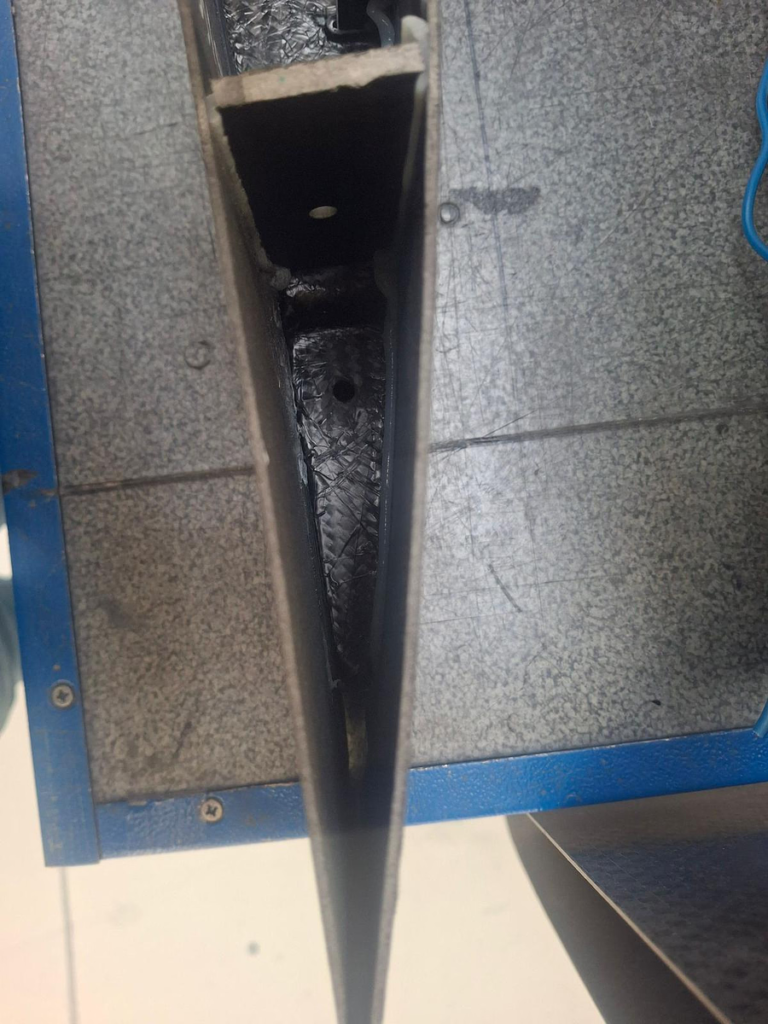
The practical result for drone manufacturers:
- Thin sandwich skins (1–2 mm core) that actually deliver the stiffness-to-weight ratio they promise on paper.
- No hidden weight penalty from resin absorption, which keeps the airframe mass predictable during production.
- The ability to use sandwich construction in small, geometrically complex parts — control surfaces, motor arms, sensor housings — where solid laminates were previously the only realistic option.
Dual-Usage Platforms: One Airframe, Two Missions
The term dual usage has become central to how modern UAV programmes are evaluated and funded. A single drone platform that serves both civilian and defence roles — agricultural survey by day, ISR (intelligence, surveillance, reconnaissance) by night — represents a far more efficient investment than two purpose-built airframes.
Dual-usage capability places specific demands on structural materials. The airframe needs to be light enough for long-endurance civilian missions, stiff enough for high-speed military profiles, and thermally stable enough to tolerate the heat generated by electronics payloads, onboard processing units, and in some cases proximity to propulsion exhaust.
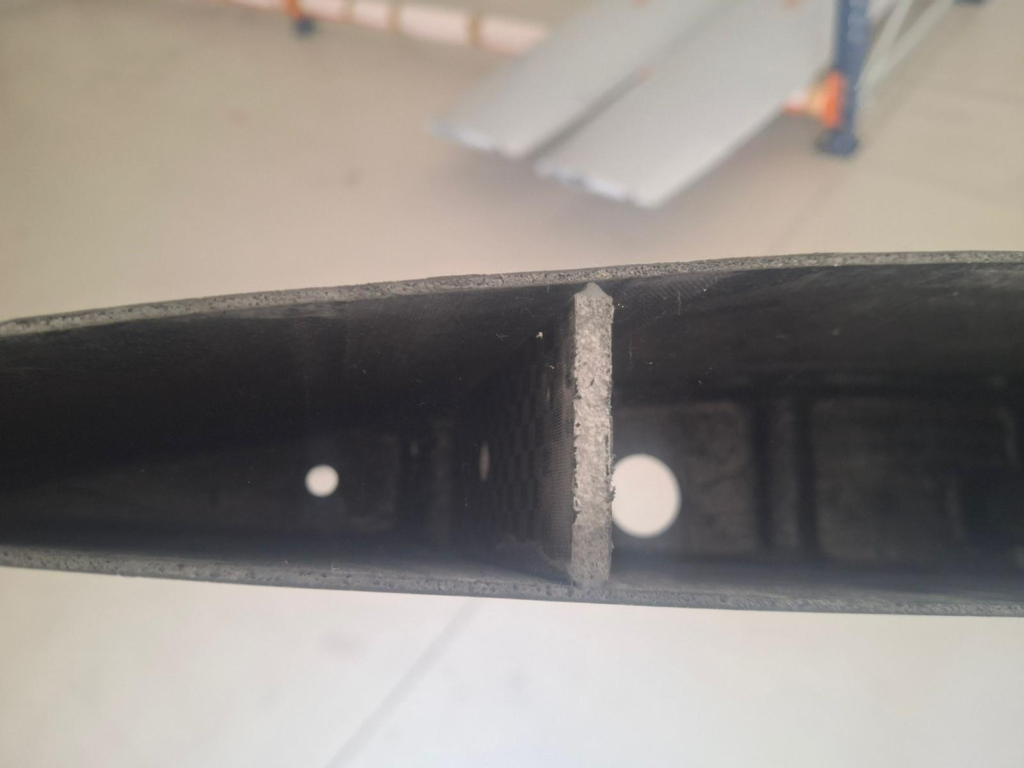
ROHACELL® checks all three boxes. Grades like ROHACELL® IG-F offer excellent machinability for complex UAV geometries, while ROHACELL® XT provides the thermal headroom needed for high-temperature cure cycles and demanding operational environments. For components requiring RF transparency — radomes, antenna fairings, communication housings — ROHACELL® HF delivers minimal signal attenuation alongside its structural performance.
- Structural panels, wing skins, and fuselage sections benefit from PMI’s stiffness at densities as low as 31 kg/m³.
- Antenna-integrated structures can use ROHACELL® HF to combine load-bearing and RF-transparent functions in a single part, reducing assembly complexity.
- Thermally loaded areas near motors or avionics bays can incorporate higher-density ROHACELL® grades without risk of core degradation during operation.
Lighter Airframe, Longer Range, Greater Capability
The relationship between airframe weight and drone performance is almost linear in the endurance regime most operators care about. A lighter structure means less energy drawn from the battery per kilometre flown. That translates directly into longer range, extended loiter time, and the ability to carry heavier or more varied payloads without sacrificing mission duration.
By enabling true sandwich construction at thicknesses where other foams fail, ROHACELL® gives drone designers a tool that conventional materials simply cannot replicate. A wing skin built with a 1.5 mm PMI core and carbon face sheets will be stiffer, lighter, and more dimensionally stable than the same geometry built with PVC — and the weight difference compounds across every panel on the airframe.
This is not a theoretical advantage. Drone manufacturers working with thin-section sandwich panels have reported measurable improvements in endurance and payload fraction after switching from PVC or PET cores to ROHACELL® — particularly in fixed-wing platforms where aerodynamic efficiency and structural weight are tightly coupled.
A Material Matched to the Sector’s Trajectory
The UAV industry is moving toward longer missions, heavier sensor packages, and airframes that must serve multiple roles without structural compromise. These trends favour materials that perform reliably at low thicknesses, resist resin uptake, and maintain their properties across a wide operational temperature range. ROHACELL® was not designed specifically for drones — but the properties that made it indispensable in manned aerospace turn out to be exactly what unmanned platforms need as they grow in complexity and ambition.