Structural foam cores have gone through decades of incremental progress. PMI chemistry changed the trajectory entirely — here’s what happened and why it matters for modern composites.
Where It All Started: PVC and PET Foams
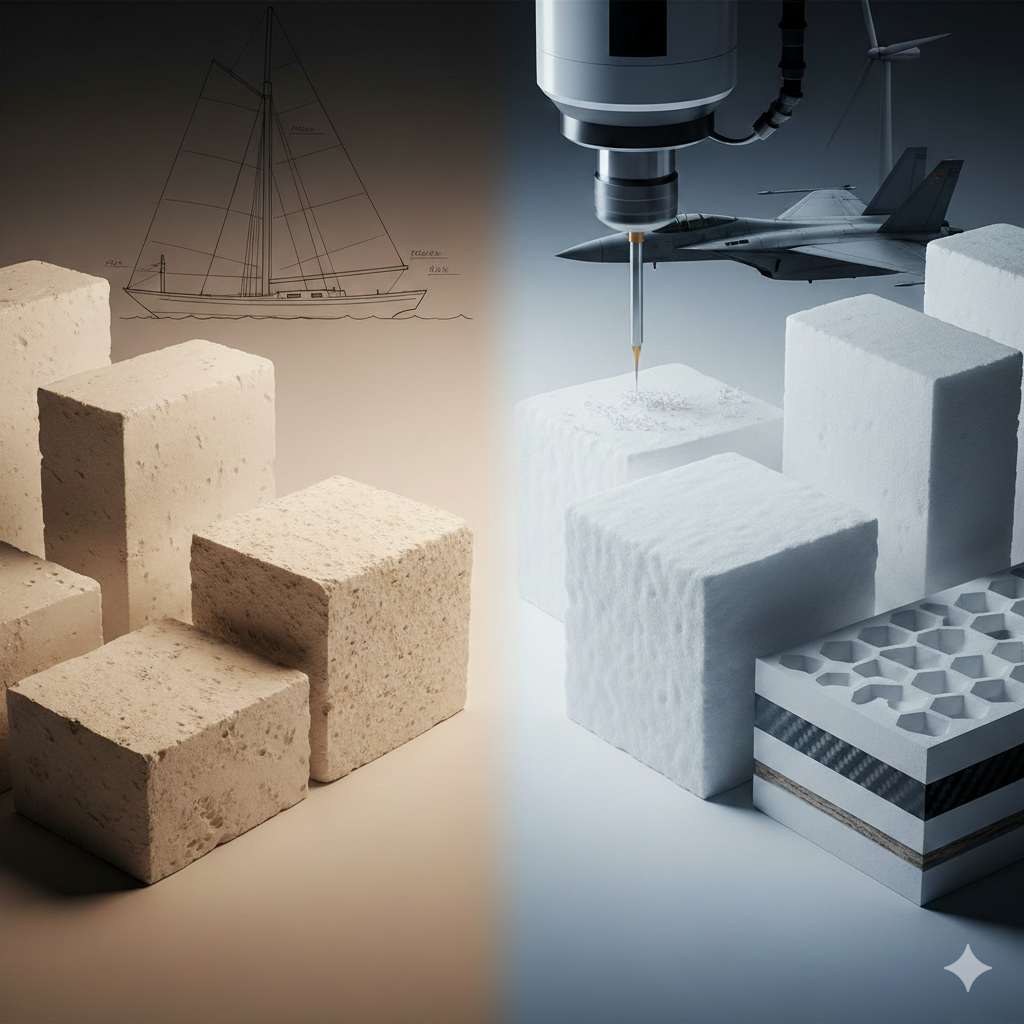
For a long time, sandwich construction in composites relied on a fairly narrow selection of core materials. PVC (polyvinyl chloride) foams became standard in marine and wind energy applications during the 1970s and 80s, offering a reasonable balance between cost and stiffness. PET (polyethylene terephthalate) followed as a recyclable alternative with decent shear properties. Together, these two chemistries dominated the structural foam market for the better part of three decades.
Both served the industry well enough, but they share a set of limitations that become hard to ignore at higher performance levels:
- Thermal ceiling around 70–80°C — PVC and PET cores soften or degrade under autoclave conditions, restricting their use in aerospace-grade curing cycles where temperatures routinely exceed 120°C.
- Significant resin uptake during infusion, especially at lower thicknesses, which adds parasitic weight and drives up material costs. In many cases, the absorbed resin can account for a surprisingly large share of total panel weight.
- Limited compressive creep resistance under sustained load and temperature, making them unsuitable for long-duration, high-pressure processing. Parts that require extended cure times at elevated pressure simply cannot rely on these cores to maintain dimensional accuracy.
These constraints pushed engineers to look elsewhere — particularly for applications where every gram of weight and every degree of thermal headroom counted. The aerospace sector felt this most acutely, but automotive and defence programmes were not far behind.
The PMI Shift: A Different Chemical Foundation
Polymethacrylimide (PMI) foam arrived as something structurally distinct from its predecessors. Rather than iterating on PVC chemistry, Evonik developed a closed-cell rigid foam with an entirely different polymer backbone, resulting in mechanical and thermal properties that traditional foams couldn’t match.
ROHACELL®, the commercial name for this PMI material, introduced a combination of traits that hadn’t existed in a single product before:
- Heat resistance up to 200°C, with certain grades tolerating autoclave pressures at 180°C — a range that opens the door to curing with BMI and high-temperature epoxy resins that PVC or PET cores would never survive.
- Compressive creep behaviour stable enough for processing at 0.7 MPa and 180°C, which means the foam holds its geometry under conditions that would collapse a conventional core. This reliability during long cure cycles is one of the reasons ROHACELL® became a standard in aircraft programmes.
- A cell structure engineerable by grade, from the ultra-fine cells of ROHACELL® RIMA (roughly 50 g/m² resin uptake) to the coarser but highly machinable structure of ROHACELL® IG-F.
This wasn’t a marginal improvement over existing foams. It was a material that unlocked manufacturing methods — especially autoclave curing — that were previously off-limits for sandwich structures. Engineers could now design panels with foam cores and process them under the same conditions they used for monolithic laminates, without worrying about core collapse or dimensional drift.
Grade Diversity: One Chemistry, Many Applications
What makes the ROHACELL® platform particularly useful is the breadth of grades available, each tuned for a specific processing window or end-use requirement. The differences between grades are not cosmetic — they reflect deliberate adjustments to cell size, density, and post-treatment that make each variant suited to a distinct manufacturing scenario.
ROHACELL® WF became the default choice for aeronautic structures — stringer-stiffened panels, pressure bulkheads, helicopter rotor blades — where MIL and CMS specifications are non-negotiable. ROHACELL® XT pushed the envelope further, handling curing temperatures as high as 240°C in pressureless post-cure scenarios, which makes it compatible with BMI resin systems used in military and space programmes. After heat treatment, the XT-HT variant can operate at temperatures of 190°C and pressures of 0.7 MPa — numbers that would be unthinkable for any PVC- or PET-based core.
On the other end of the spectrum, ROHACELL® HF found its niche in RF-transparent applications — antenna radomes, medical imaging tables, electronics housings — thanks to its extremely low dielectric constant and fine cell morphology. Its particularly fine cell structure also ensures minimal resin uptake, which further reduces component mass in applications where transmission properties and weight are equally critical.
Beyond PMI: ROHACRYL® and the Volume Question
Not every application needs the extreme thermal or mechanical performance of PMI foam. For high-volume industrial production, Evonik developed ROHACRYL®, an acrylic-chemistry foam that bridges the gap between conventional cores and ROHACELL®.
ROHACRYL® SW is recyclable, thermoformable, and offers a thermal stability of 120°C — well above PVC and PET. Its shear modulus reaches up to 47 MPa, and the closed-cell structure keeps resin uptake as low as 250 g/m². For sectors like automotive, wind energy, and marine where part volumes are high and cycle times matter, it hits a practical sweet spot that traditional foams simply miss.
- Recyclable structural foam suitable for CNC machining and thermoforming — no special tooling required.
- Thermal processing window up to 120°C, which covers the majority of industrial epoxy and polyester resin systems.
- Cost structure aligned with volume production while maintaining measurably lower resin consumption than PVC or PET alternatives.
ROHACRYL® doesn’t compete with ROHACELL® — it complements it. Where PMI targets demanding aerospace and defence applications, the acrylic platform addresses the growing need for lightweight, thermally stable cores in markets that operate at scale.
What Changed — and What Didn’t
PVC and PET foams haven’t disappeared. They still make economic sense for lower-performance sandwich panels where thermal demands are modest and weight budgets are generous. But the direction of travel in composites — lighter, hotter processing, tighter tolerances — has moved decisively toward PMI and advanced acrylic chemistries.
ROHACELL® didn’t just add another option to the catalogue. It redefined what a foam core could be asked to do: survive autoclave cycles, maintain dimensional stability under sustained load, and contribute to overall weight reduction without sacrificing structural integrity. That shift continues to shape how composite parts are designed and manufactured today.