The engineering behind helicopter rotor blades represents one of aviation’s most demanding material science challenges. These components must withstand tremendous centrifugal forces, constant vibration, and fatigue cycles that would destroy most conventional materials within hours. Understanding what goes into modern helicopter blades reveals a fascinating intersection of chemistry, physics, and practical engineering.
The Evolution From Metal to Composites
Early helicopter designs relied heavily on aluminum and steel for their rotor systems. While these metals offered predictable properties and straightforward manufacturing, they came with significant drawbacks. Metal blades are heavy, prone to corrosion, and susceptible to fatigue cracking that can propagate rapidly once initiated. Maintenance crews had to inspect them constantly, and replacement cycles were measured in hundreds of flight hours rather than thousands.
The aerospace industry began transitioning toward composite materials in the 1970s, and helicopter manufacturers were among the earliest adopters. Composite rotor blades now dominate both military and civilian helicopter production, offering service lives that often exceed the airframe itself. This shift wasn’t merely about weight savings—though those are substantial—but about fundamentally reimagining what a rotor blade could be.
Anatomy of a Modern Composite Blade
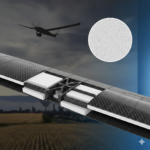
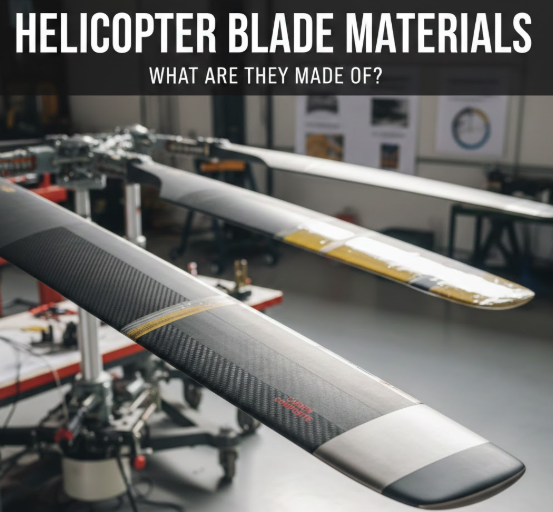
A contemporary helicopter blade isn’t a single material but rather an engineered assembly of different components working together. The outer skin typically consists of carbon fiber or fiberglass reinforced polymer, providing the aerodynamic surface and primary structural strength. Beneath this skin lies the key to modern blade performance: the core material.
Structural foam cores form the heart of sandwich construction in rotor blades. These cores maintain the blade’s shape under load while adding minimal weight. The relationship between the skin and core creates a structure similar to an I-beam—tremendous strength and stiffness with relatively little material.
The leading edge often incorporates erosion protection, typically a nickel or titanium strip bonded to the composite structure. Trailing edges may be filled with honeycomb or foam materials depending on the design requirements. Some blades also incorporate de-icing systems, lightning protection, and embedded sensors for health monitoring.
Why Foam Cores Matter
Not all foam materials are suitable for helicopter applications. The rotor environment subjects materials to:
- Repeated stress cycles numbering in the millions over a blade’s lifetime
- Temperature extremes from high-altitude operations to hot desert conditions
- Vibration frequencies that can excite resonance in poorly chosen materials
- Manufacturing processes involving elevated temperatures and pressures
Polymethacrylimide (PMI) foams have become the preferred choice for demanding rotor applications. Materials like ROHACELL® WF were specifically designed for aerospace use, satisfying stringent military and commercial specifications. This particular grade appears frequently in main and tail rotor blades, as well as fuselage panels, because it maintains its properties across the temperature and pressure ranges encountered in service.
The selection criteria for rotor blade cores extend beyond simple strength measurements. Engineers must consider creep resistance—the tendency of materials to slowly deform under sustained load. A foam that performs well in short-term testing might gradually compress over years of service, altering the blade’s aerodynamic profile and potentially creating dangerous imbalances.
Processing Considerations
Manufacturing composite helicopter blades requires precise control over temperature, pressure, and timing. The core material must survive the curing process without crushing, outgassing, or degrading. Autoclave processing at temperatures approaching 180°C and pressures around 0.45 MPa demands core materials with exceptional stability.
Different grades serve different manufacturing approaches. ROHACELL® XT handles the most demanding autoclave conditions, tolerating temperatures up to 180°C at 0.45 MPa—or even higher after heat treatment. For vacuum infusion and resin transfer molding (RTM), other grades offer optimized cell structures that minimize resin absorption while maintaining structural integrity.
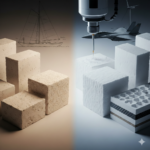
The thermoformability of PMI foams provides manufacturing flexibility that metal cores simply cannot match. Complex blade geometries can be achieved by heating the foam and forming it to shape before the composite layup begins. This capability reduces machining requirements and allows tighter tolerances on the finished part.
Weight and Performance Implications
Every gram saved in a rotor blade pays dividends throughout the helicopter’s design. Lighter blades require less powerful drive systems, which means smaller engines, less fuel consumption, and greater payload capacity. The cascading effects of blade weight reduction touch nearly every aspect of helicopter performance.
Consider that a typical medium helicopter might have four main rotor blades, each weighing 80-120 kilograms. Reducing that weight by even 5% translates to meaningful improvements in:
- Hover ceiling and hot-day performance
- Fuel efficiency across all flight regimes
- Fatigue loads on the transmission and hub components
- Overall aircraft empty weight and useful load
The strength-to-weight ratio of PMI foam cores contributes directly to these performance gains. Traditional materials cannot approach the same combination of low density and high mechanical properties that modern structural foams provide.
Durability and Maintenance
Composite blades with properly selected core materials have transformed helicopter maintenance economics. Where metal blades required frequent inspections and had limited service lives, modern composite designs often carry “on-condition” maintenance schedules. If inspection reveals no damage, the blade continues flying.
The closed-cell structure of quality foam cores resists moisture ingress, which plagued earlier composite designs using honeycomb cores. Water trapped in honeycomb cells adds weight, shifts balance, and can freeze at altitude—all serious concerns for rotor blades. Fine-celled PMI foams largely eliminate these moisture-related issues.
Repair procedures for composite blades have also matured. Minor damage can often be addressed in the field, while more significant repairs follow well-established protocols. The foam core’s predictable properties make damage assessment and repair verification straightforward compared to honeycomb structures.
Looking Ahead
Helicopter blade technology continues advancing. Manufacturers experiment with hybrid constructions, active twist systems, and morphing geometries that would be impossible with metal blades. Each innovation places new demands on core materials, driving development of even more capable foam products.
The trend toward urban air mobility and electric vertical takeoff and landing (eVTOL) aircraft creates fresh opportunities for lightweight structural materials. These new vehicle categories prioritize weight savings even more than traditional helicopters, as battery energy density remains a limiting factor. High-performance foam cores will play an essential role in making these aircraft practical.
What began as a simple question—what are helicopter blades made of?—leads into a rich territory of materials science and engineering optimization. The answer involves carefully selected composites, precision manufacturing, and core materials engineered specifically for one of aviation’s most challenging applications. Modern PMI foams represent decades of development aimed at meeting these exacting requirements, and their continued evolution promises even more capable helicopter designs in the years ahead.