The transportation industry finds itself at an inflection point. Regulatory pressure to reduce emissions, rising fuel costs, and consumer demand for more efficient vehicles have pushed manufacturers to fundamentally rethink how they build everything from delivery vans to passenger trains. At the center of this transformation sits an unlikely hero: structural foam cores that enable lightweight composite construction without sacrificing durability or safety.
Weight Reduction as a Design Philosophy
Every kilogram stripped from a commercial vehicle pays dividends over its operational lifetime. Fleet operators calculate that each 100 kg of weight reduction translates to approximately 1-2% fuel savings, depending on the vehicle type and operating conditions. For a delivery truck covering 50,000 kilometers annually, those savings compound into meaningful reductions in operating costs and carbon footprint.
Traditional vehicle construction relied on steel and aluminum for structural components. While these metals offer excellent strength, their density limits how light a vehicle can become without compromising safety. Composite sandwich construction—where high-strength skins bond to a lightweight core—offers a path around this limitation. The resulting structures can match or exceed metal performance while weighing substantially less.
Understanding Sandwich Construction
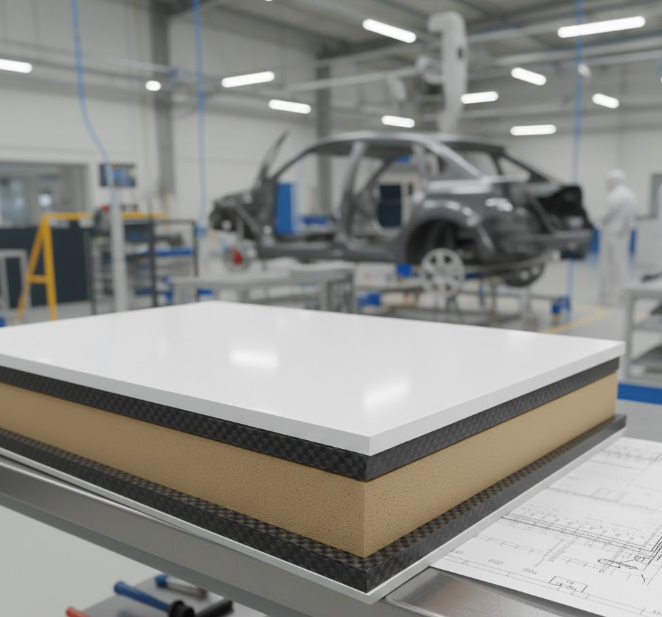
The sandwich panel concept borrows from nature. Think of how a bird’s bone achieves remarkable stiffness while remaining light enough for flight—a dense outer layer surrounding a less dense interior. Engineering sandwich panels work similarly, with thin, strong face sheets separated by a thick, low-density core.
The core material determines much of the panel’s performance characteristics. It must resist crushing under load, maintain its shape during manufacturing, and bond reliably to the face sheets. Foam cores based on polymethacrylimide (PMI) chemistry have emerged as the premium choice for demanding transportation applications. These closed-cell foams offer exceptional strength-to-weight ratios and can withstand the elevated temperatures encountered during composite curing.
Material selection depends heavily on the manufacturing process. Autoclave curing subjects cores to both high temperatures and pressures, requiring materials that won’t crush or outgas. Vacuum infusion and resin transfer molding (RTM) impose different demands, emphasizing low resin uptake and dimensional stability. Matching the core grade to the process ensures optimal results.
Applications Across the Transportation Sector
Commercial vehicles present diverse opportunities for composite adoption. The specific requirements vary by application, but the underlying value proposition remains consistent: achieve the required structural performance with less weight.
Delivery and logistics vehicles benefit from foam-cored composites in several areas:
- Cargo box walls and floors that reduce vehicle tare weight while maintaining durability
- Roof panels that improve thermal insulation for refrigerated transport
- Structural floor sections that handle cargo loads without excessive weight penalty
Public transit applications have embraced composites enthusiastically. Bus manufacturers use sandwich panels for interior and exterior body panels, achieving weight reductions that directly improve fuel economy and passenger capacity. Rail vehicles incorporate foam-cored composites in flooring, sidewalls, and ceiling panels, where fire resistance and mechanical performance must meet stringent standards.
The marine industry, though not strictly ground transportation, shares many of the same drivers. Commercial vessels from ferries to fishing boats increasingly specify structural foam cores for decks, superstructures, and interior components. Weight savings translate directly to improved fuel efficiency and cargo capacity.
Manufacturing Considerations
Transitioning from metal to composite construction requires more than simply substituting materials. Design philosophies, tooling, and quality control processes all need adjustment. However, the maturity of composite technology means that well-established practices exist for each step.
High-volume production demands cores that can be processed quickly and reliably. Newer acrylic-based foam formulations offer thermal stability up to 120°C while maintaining very low resin uptake—around 250 g/m² in some cases. This combination allows faster cure cycles without excessive resin consumption, addressing both production speed and material cost concerns.
Process selection influences core requirements significantly:
- Hand layup applications tolerate a wider range of core properties but benefit from easy-to-handle sheet materials
- RTM processes require cores that resist resin pressure without crushing or distorting
- Vacuum infusion demands cores with minimal resin absorption to control part weight and material costs
Economic and Environmental Drivers
The business case for lightweight composites strengthens as regulatory requirements tighten. European Union emissions standards for commercial vehicles have become progressively more stringent, with similar trends in North America and Asia. Electric commercial vehicles face an even more acute need for weight reduction, as every kilogram of vehicle mass reduces battery range.
Lifecycle analysis increasingly favors composite construction despite higher initial material costs. The combination of fuel savings, reduced maintenance requirements, and longer service life often results in lower total cost of ownership compared to traditional metal construction. For fleet operators making purchasing decisions based on multi-year economics, these factors carry significant weight.
Recyclability has emerged as an important consideration. Modern structural foams can often be recovered and reprocessed at end of vehicle life, addressing concerns about composite waste streams. This capability matters increasingly to manufacturers facing extended producer responsibility requirements.
The Role of Material Partners
Selecting appropriate core materials requires understanding both the application requirements and the available product grades. Different foam densities serve different purposes—lower densities minimize weight while higher densities provide greater load-bearing capacity. Working with knowledgeable distributors who understand composite processing methods proves invaluable during material selection and process development.
Technical support extends beyond simple product selection. Experienced partners can advise on processing parameters, troubleshoot manufacturing issues, and help optimize designs for production efficiency. This collaborative approach accelerates development timelines and reduces the risk of costly mistakes.
Companies like CHEM-CRAFT specialize in bridging the gap between foam manufacturers and end users. Their engineering teams understand processes ranging from hand layup to autoclave curing, allowing them to recommend appropriate PMI foam grades based on specific application requirements rather than generic specifications.
Looking Forward
The transportation sector’s appetite for lightweight materials shows no signs of diminishing. If anything, emerging vehicle categories—from autonomous delivery robots to electric urban mobility solutions—push weight sensitivity even further. The foam core materials serving today’s commercial vehicles will continue evolving to meet these demands, offering higher performance, easier processing, and improved sustainability profiles.
For manufacturers evaluating composite adoption, the technology has matured to the point where proven solutions exist for most applications. The question is no longer whether composites can work for transportation, but which specific material combinations and processes best serve each application’s unique requirements. The compounding benefits of weight reduction across fuel efficiency, payload capacity, and vehicle longevity make the investment case increasingly compelling for forward-thinking fleet operators and vehicle manufacturers alike.